Iole
Videos
In Greek mythology, Iole was the daughter of King Eurytus of Oechalia. According to the brief epitome in the Bibliotheca, Eurytus had a beautiful young daughter named Iole who was eligible for marriag

Iole with Heracles in the house of Eurytus, as depicted on the seventh-century Eurytos column-crater, Louvre. Iole's name is given in its Corinthian (Doric) form Ϝιόλᾱ ("Viola"), with digamma and a local Σ-shaped form for iota. It is located under the name of Heracles in the right upper corner of the image.

Santi di Tito: Iole and Hercules

Heracles abducts Iole, second century AD relief, Archaeological Museum of Piraeus.

Woodcut illustration of Hercules (dressed as both a man and a woman) and Iole
Nessus (centaur)
Videos
In Greek mythology, Nessus was a famous centaur who was killed by Heracles, and whose poisoned blood in turn killed Heracles. He was the son of Centauros. He fought in the battle with the Lapiths and
Iole
…she forbore to object and tolerated it temporarily. Deianira feared she would lose Heracles to the younger and more beautiful Iole. Years earlier, the centaur Nessus had ferried her across the river Evenus and attempted to rape her when they were on the other side. Heracles saved her from Nessus by shooting him with…
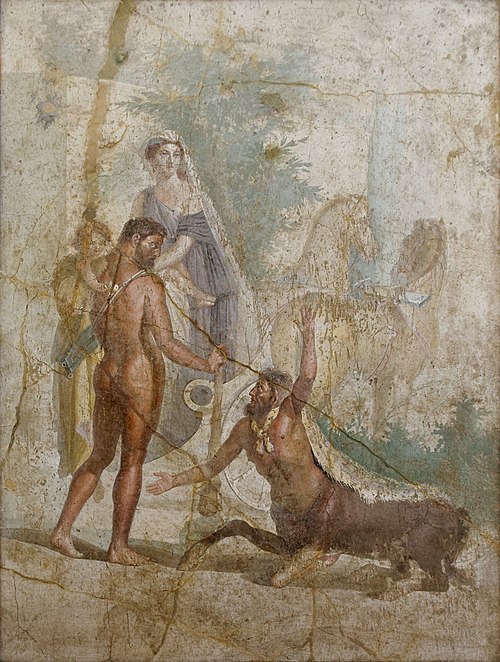
Heracles carrying his son Hyllus looks at the centaur Nessus, who is about to carry Deianira across the river on his back. Antique fresco from Pompeii

Guido Reni, Abduction of Deianira, 1620–21, Louvre Museum

Enrique Simonet, Nessus and Deianira, 1888

2006 picture of Laurent Marqueste's statue of Nessus struck by an arrow while carrying off Deianeira