Iota Horologii, Latinized from ι Horologii, is a yellow-hued star approximately 56.5 light-years away in the Horologium constellation. The star is classified as a G0Vp yellow dwarf. It has a mass and radius larger than the Sun, and is about 50% more luminous.
Credit: Digital Sky Survey/VirGO
Horologium (constellation)
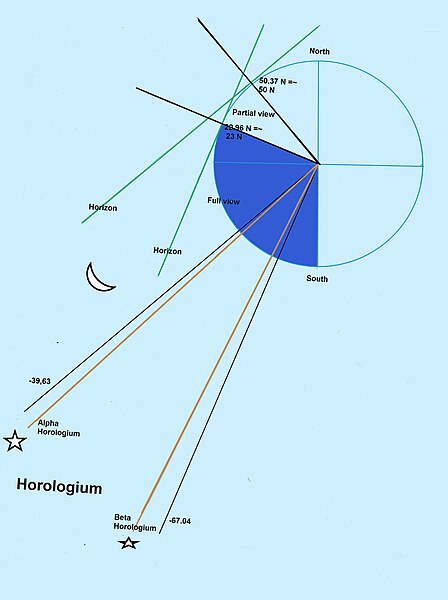
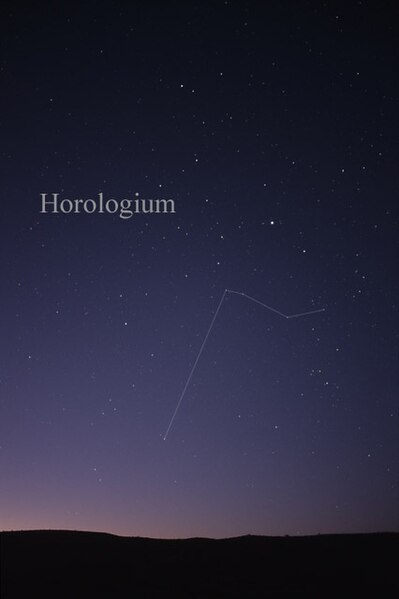
Horologium is a constellation of six stars faintly visible in the southern celestial hemisphere. It was first described by the French astronomer Nicolas-Louis de Lacaille in 1756 and visualized by him as a clock with a pendulum and a second hand. In 1922 the constellation was redefined by the International Astronomical Union (IAU) as a region of the celestial sphere containing Lacaille's stars, and has since been an IAU designated constellation. Horologium's associated region is wholly visible to observers south of 23°N.
Horologium constellation: showing the tangent line, or viewer's horizon, at latitude approx 23°N, which is parallel to the line of −67.04 declension, the lower declination boundary of the constellation.
The constellation Horologium as it can be seen by the naked eye
Composite image of NGC 1512 (left) and the dwarf galaxy NGC 1510