Irish Free State
Videos
The Irish Free State, also known by its Irish name Saorstát Éireann, was the Irish state established in December 1922 under the Anglo-Irish Treaty of December 1921, initially as a Dominion. The treaty

Funeral procession of Michael Collins, Dublin, 1922

Irish Free State passport (holder's name removed)

Overprinted stamp

Poster promoting Irish Free State farm goods for breakfast to Canadians ("Irish Free State butter, eggs and bacon for our breakfasts")
The United Kingdom of Great Britain and Ireland was established by the Acts of Union in 1801 that united the Kingdom of Great Britain and the Kingdom of Ireland into one unitary and sovereign state. I
Irish Free State
…by the Royal and Parliamentary Titles Act 1927, which changed the king's royal title so that it took account of the fact that there was no longer a United Kingdom of Great Britain and Ireland. The king adopted the following style by which he would be known in all of his empire: By the Grace of God, of Great Britain, Ireland and the British…

The signing of the Treaty of Ghent ending the war with the United States (by Amédée Forestier, c. 1915)

A painting by James Pollard showing Trafalgar Square before the erection of Nelson's Column
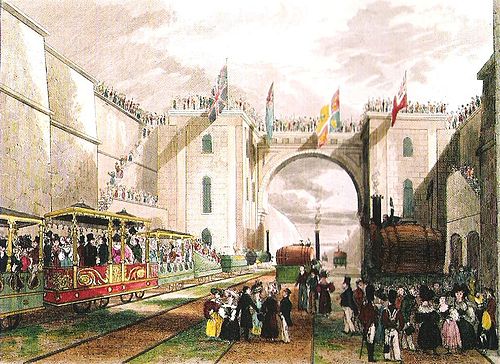
Opening of the Liverpool and Manchester Railway in 1830

The House of Commons, 1833 by George Hayter commemorates the passing of the Reform Act 1832. It depicts the first session of the newly reformed House of Commons on 5 February 1833. In the foreground, the leading statesmen from the Lords: Charles Grey, 2nd Earl Grey (1764–1845), William Lamb, 2nd Viscount Melbourne (1779–1848) and the Whigs on the left; and Arthur Wellesley, 1st Duke of Wellington (1769–1852) and the Tories on the right.