Israel–Jordan peace treaty
Videos
The Israel–Jordan peace treaty, sometimes referred to as the Wadi Araba Treaty, is an agreement that ended the state of war that had existed between the two countries since the 1948 Arab–Israeli War a

U.S. President Bill Clinton (center) watches Jordan's King Hussein (left) and Israeli Prime Minister Yitzhak Rabin (right) sign the Washington Declaration on the White House lawn

President Bill Clinton with King Hussein of Jordan, Israeli Prime Minister Benjamin Netanyahu and Palestinian leader Yasser Arafat in October 1996

Shimon Peres (left) with Yitzhak Rabin (center) and King Hussein of Jordan (right), prior to signing the Israel–Jordan peace treaty.

A handshake between King Hussein and PM Rabin, accompanied by President Clinton, during the Israel-Jordan peace negotiations, 25 July 1994
Jordan
Videos
Jordan, officially the Hashemite Kingdom of Jordan, is a country in the Southern Levant region of West Asia. Jordan is bordered by Syria to the north, Iraq to the east, Saudi Arabia to the south, and
Israel–Jordan peace treaty
…staging ground for military strikes by a third country. The signing ceremony took place at the southern border crossing of Arabah on 26 October 1994. Jordan was the second Arab country, after Egypt, to sign a peace accord with Israel. In 1987 Israeli foreign affairs minister Shimon Peres and King Hussein…

The 'Ain Ghazal Statues, c. 7250 BC, uncovered in Amman, are some of the oldest human statues ever found.
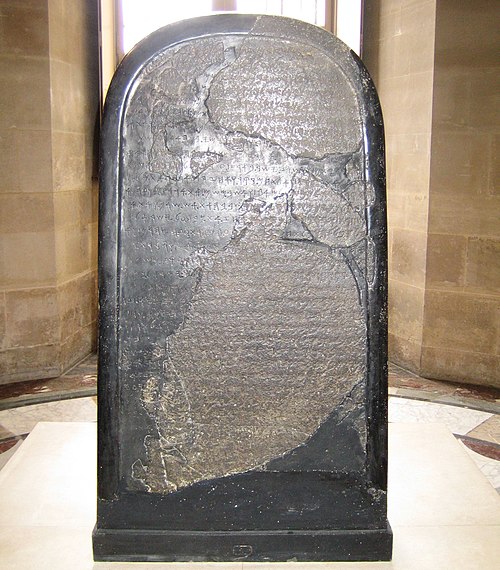
The Mesha Stele (c. 840 BC) records the glory of Mesha, King of Moab, displayed at the Louvre Museum.

Petra, one of the New 7 Wonders of the World, contains Al-Khazneh, believed to be the mausoleum of the Nabataean King Aretas IV, 1st century AD.

The Oval Forum of Jerash (c. 1st century AD), then member of the ten-city Greco-Roman league, the Decapolis, seven of which are present in modern-day Jordan