Japanese era name
Videos
The Japanese era name or nengō, is the first of the two elements that identify years in the Japanese era calendar scheme. The second element is a number which indicates the year number within the era,

Keizō Obuchi, Chief Cabinet Secretary, announces the name of the new era "Heisei" (平成), on 7 January 1989.

Yoshihide Suga, Chief Cabinet Secretary, announces the name of the new era "Reiwa" (令和) at the Prime Minister's Official Residence, on 1 April 2019.

1729 Japanese calendar, which used the Jōkyō calendar procedure, published by Ise Grand Shrine
Meiji era
Videos
The Meiji era was an era of Japanese history that extended from October 23, 1868, to July 30, 1912. The Meiji era dominated the first half of the Empire of Japan, when the Japanese people moved from b
Japanese era name
…re-adopted in 701 during the reign of Emperor Monmu (697–707). Since then, era names have been used continuously up through the present day. Prior to the Meiji period, era names were decided by court officials and were subjected to frequent change. A new era name was usually proclaimed within a year or two after the…

Emperor Meiji (1872)

The fifteen-year-old Meiji Emperor, moving from Kyoto to Tokyo at the end of 1868, after the fall of Edo

Emperor Meiji c. 1888
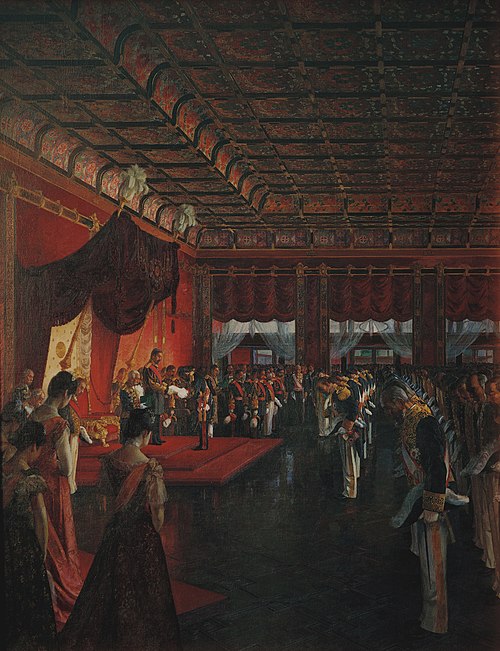
Ceremony for the Promulgation of the Constitution by Wada Eisaku, showing the Emperor presenting the Constitution to Prime Minister Kuroda Kiyotaka at a ceremony in the Imperial Palace on 11 February 1889 (Meiji Memorial Picture Gallery)