John Fortescue (judge)
Videos
Sir John Fortescue, of Ebrington in Gloucestershire, was Chief Justice of the King's Bench and the author of De Laudibus Legum Angliae, first published posthumously circa 1543, an influential treatise
Depiction of a Chief Justice of the King's Bench contemporary to Fortescue's term in office

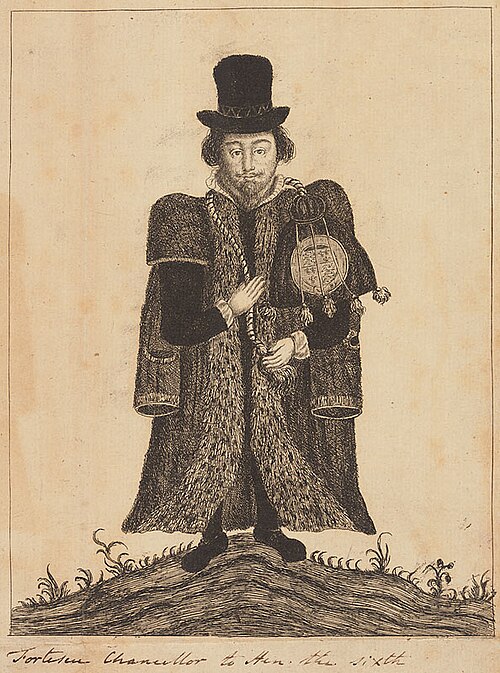
A drawing of Fortescue in anachronistic 17th-century dress with an oversized Great Seal of England, from the Legal Portrait Collection of Harvard Law School Library

Monument with recumbent painted effigy of Sir John Fortescue in the Church of St Eadburga, Ebrington

The title page of Fortescue's De laudibus legum Angliæ (In Commendation of the Laws of England, 1616 edition)
Blackstone's ratio
Videos
In criminal law, Blackstone's ratio is the ratio between letting guilty go unpunished and convicting innocent people, two forms of miscarriage of justice. There is also a long history of similar senti
John Fortescue (judge)
…Commendation of the Laws of England, first published posthumously around 1543), in which he made an early expression of what would later become known as Blackstone's formulation, stating that "one would much rather that twenty guilty persons should escape the punishment of death, than that one innocent person should be condemned…

Statue of William Blackstone located at Constitution Ave & 3rd St. NW, Washington, D.C.