José Joaquim da Rocha was a Brazilian painter, engraver, gilder and restorer. His entire production was in the field of religious art, with the Catholic Church as his exclusive patron. He left numerous works of a scholarly character, moving away from the popular tradition that was common during the colonial period. Although his work has many moments of high level, it is uneven, partly because, since he became recognized, he always had many disciples and apprentices to assist him, to whom he delivered large portions of the work, and partly because of the use, as inspiration, of a varied iconography in engraving of irregular quality. Both practices were, however, common at the time.
The ceiling of the Basilica of the Immaculate Conception, in Salvador, his most famous work
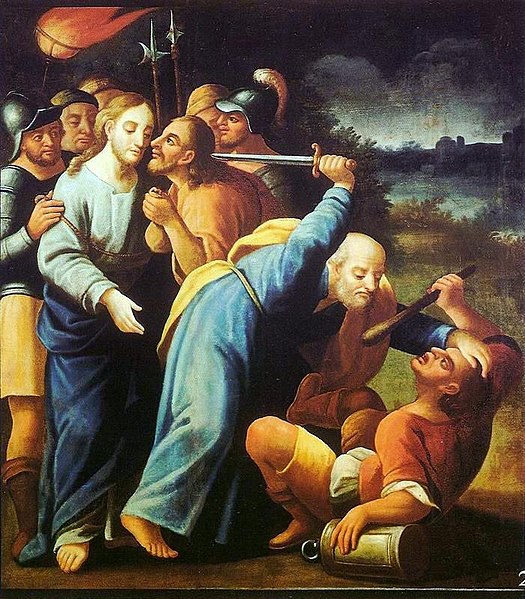
The kiss of Judas and Peter cutting off Malchus' ear. Flag of the Procession of Bonfires. Holy House of Mercy of Bahia
Jewish priest offering bread and wine, Museum of Sacred Art of Bahia
Flagellation of Christ. Flag of the Procession of Bonfires. Museum of Sacred Art of Bahia
The Baroque in Brazil was the dominant artistic style during most of the colonial period, finding an open ground for a rich flowering. It made its appearance in the country at the beginning of the 17th century, introduced by Catholic missionaries, especially Jesuits, who went there in order to catechize and acculturate the native indigenous peoples and assist the Portuguese in the colonizing process. In the course of the Colonial period, expressed a close association between the Church and the State, but in the colony there was not a court that would serve as a patron of the arts, the elites did not bother to build palaces, or to help sponsor the profane arts, but at the end of the period, and how the religion had a strong influence on the daily lives of everyone in this group of factors derives from the vast majority of the legacy of the Brazilian Baroque period, is the sacred art: statuary, painting, and the work of carving for the decoration of churches and convents, or for private worship.
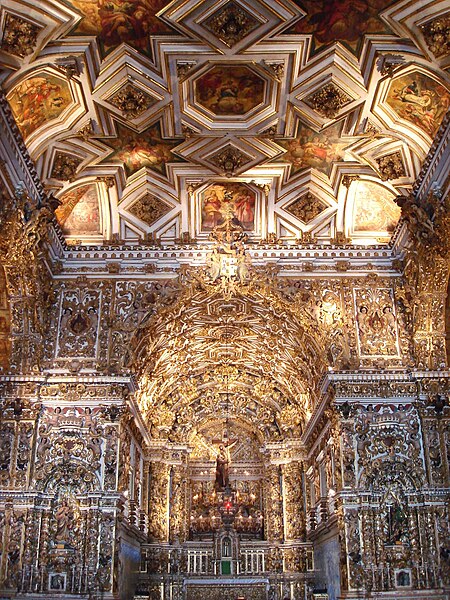
Church and Convent of São Francisco, Salvador
Pope St. Peter, from the most learned Portuguese school. Museum of Sacred Art of São Paulo
Art of the Jesuit Mission, of Spanish and Italian origin: São Francisco Xavier, Museu Júlio de Castilhos
Anonymous. Êxtase de Santa Teresa, Igreja do Convento do Carmo, São Cristóvão.