Judicial murder is the intentional and premeditated killing of an innocent person by means of capital punishment; therefore, it is a subset of wrongful execution. The Oxford English Dictionary describes it as "death inflicted by process of law, capital punishment, esp. considered to be unjust or cruel". Judicial murder is not to be confused with judicial homicide, which may include the carrying out of capital punishment.
Adolf Reichwein before a Nazi People's Court. He was a victim of judicial murder after a show trial.
Capital punishment, also known as the death penalty and formerly called judicial homicide, is the state-sanctioned practice of killing a person as a punishment for a crime, usually following an authorised, rule-governed process to conclude that the person is responsible for violating norms that warrant said punishment. The sentence ordering that an offender be punished in such a manner is known as a death sentence, and the act of carrying out the sentence is known as an execution. A prisoner who has been sentenced to death and awaits execution is condemned and is commonly referred to as being "on death row". Etymologically, the term capital refers to execution by beheading, but executions are carried out by many methods, including hanging, shooting, lethal injection, stoning, electrocution, and gassing.
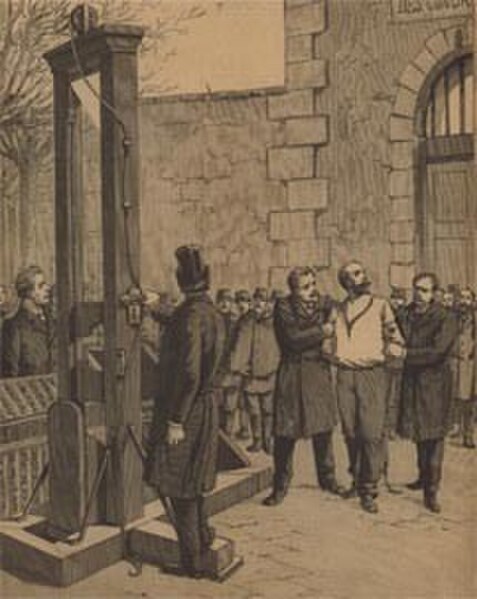
Anarchist Auguste Vaillant about to be guillotined in France in 1894
The Christian Martyrs' Last Prayer, by Jean-Léon Gérôme (1883). Roman Circus Maximus.
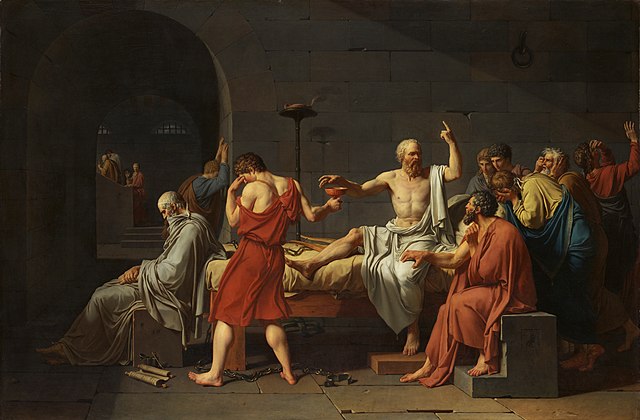
The Death of Socrates (1787), in the Metropolitan Museum of Art in New York City
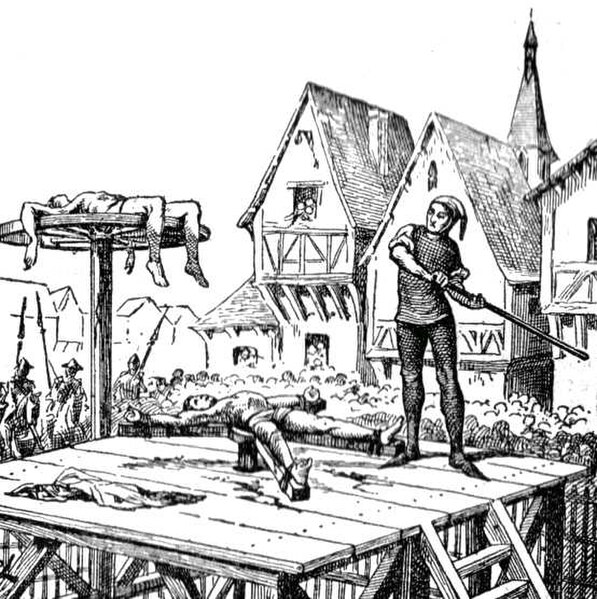
The breaking wheel was used during the Middle Ages and was still in use into the 19th century.