A junk is a type of Chinese sailing ship with fully battened sails. Similar junk sails were also adopted by other East Asian countries, most notably Japan, where junks were used as merchant ships to trade goods with China and Southeast Asia. They were found – and in lesser numbers, are still found – throughout Southeast Asia and India, but primarily in China. Historically, a Chinese junk could be one of many types of small coastal or river ships, usually serving as a cargo ship, pleasure boat, or houseboat, but also ranging in size up to large ocean-going vessel. Found more broadly today is a growing number of modern recreational junk-rigged sailboats. There can be significant regional variations in the type of rig or the layout of the vessel; however, they all employ fully battened sails.
Junks in Guangzhou, photograph c. 1880 by Lai Afong
A kai-sen of Ryukyu, 19th century
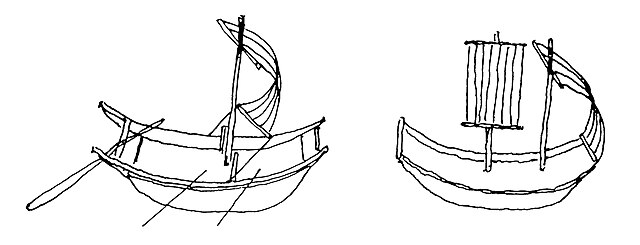
Tracing of two ships from Dunhuang cave temple, c. 8th–9th century CE. The ships showed square sails.
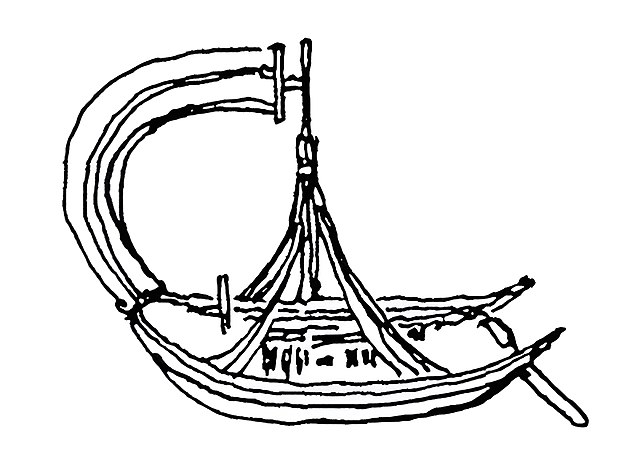
Tracing of a ship on a mirror in the Shaanxi museum (>9th or >12th century CE).
A sailing ship is a sea-going vessel that uses sails mounted on masts to harness the power of wind and propel the vessel. There is a variety of sail plans that propel sailing ships, employing square-rigged or fore-and-aft sails. Some ships carry square sails on each mast—the brig and full-rigged ship, said to be "ship-rigged" when there are three or more masts. Others carry only fore-and-aft sails on each mast, for instance some schooners. Still others employ a combination of square and fore-and-aft sails, including the barque, barquentine, and brigantine.
A barque—a three-masted sailing ship with square sails on the first two masts (fore and main) and fore-and-aft sails on the mizzenmast
Fijian voyaging outrigger boat with a crab claw sail, an example of a typical Austronesian vessel with outriggers and a fore-and-aft sail
A carved stone relief panel showing a Borobudur ship (Austronesian) from 8th century Java, depicted with outriggers and fore-and-aft tanja sails
Chinese junk Keying with a center-mounted rudder post, c. 1848