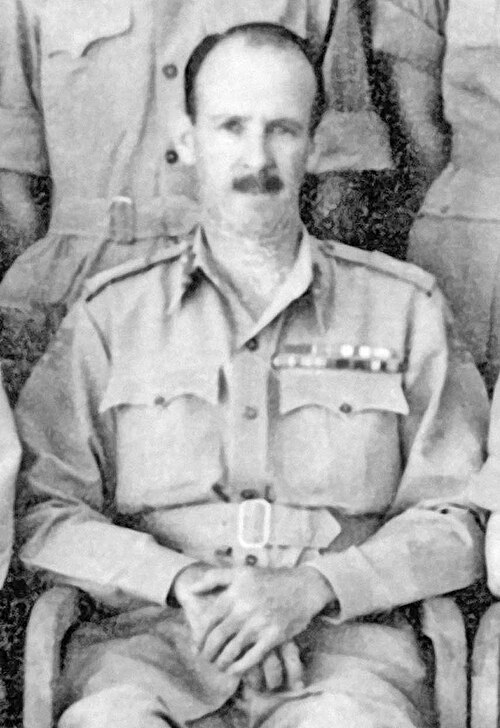
Field Marshal Kodandera Madappa Cariappa, was an Indian military officer and diplomat who was the Indian Commander-in-Chief (C-in-C) of the Indian Army. He led Indian forces on the Western Front during the Indo-Pakistani War of 1947. He was appointed Commander-in-Chief of the Indian Army in 1949. He is one of only two Indian Army officers to hold the five-star rank of Field Marshal; the other being Field Marshal Sam Manekshaw.
Cariappa on a 1995 stamp of India
President Giani Zail Singh presenting the rank of Field Marshal to Cariappa
COAS Gen Dalbir Singh Suhag paying tributes at the FM Cariappa Memorial at Madikeri, Coorg
The Indian Army is the land-based branch and largest component of the Indian Armed Forces. The President of India is the Supreme Commander of the Indian Army, and its professional head is the Chief of Army Staff (COAS). The Indian Army was established on 1 April 1895 alongside the long established presidency armies of the East India Company, which too were absorbed into it in 1903. Some princely states maintained their own armies which formed the Imperial Service Troops which, along with the Indian Army formed the land component of the Armed Forces of the Crown of India, responsible for the defence of the Indian Empire. The Imperial Service Troops were merged into the Indian Army after independence. The units and regiments of the Indian Army have diverse histories and have participated in several battles and campaigns around the world, earning many battle and theatre honours before and after Independence.
No. 4 (Hazara) Mountain Battery with RML7 pounder "Steel Gun" Mountain Gun in Review Order. Left to right Naick, Havaldar, Subadar (Sikhs) and Gunner (Punjabi Musalman) c. 1895.
Indian Cavalry on the Western Front during World War I.
A Sikh soldier of the 4th Division (the Red Eagles) of the Indian Army, attached to the British Fifth Army in Italy. Holding a captured Nazi flag after the surrender of German forces in Italy, May 1945. Behind him, a fascist inscription says "VIVA IL DUCE", "Long live the Duce" (i.e. Mussolini).
Major General El Edroos (at right) offers his surrender of the Hyderabad State Forces to Major General (later Army Chief) J.N. Chaudhuri at Secunderabad