Kingdom of Germany
Videos
In medieval history, the Kingdom of Germany was the original core of the Holy Roman Empire, which continued to be distinguished from other parts of the empire such as the Kingdom of Italy and the King
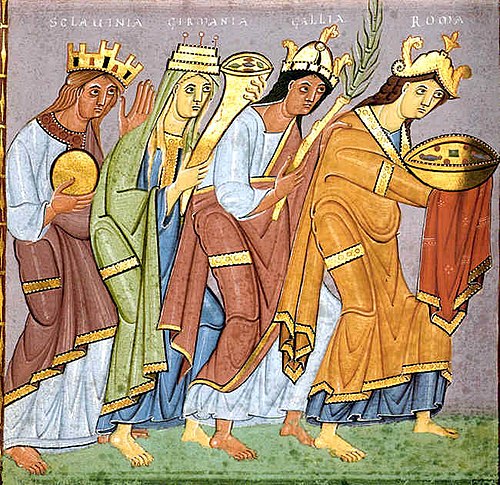
Personifications of Sclavinia ("land of the Slavs"), Germania, Gallia (France), and Roma (Italy), bringing offerings to Otto III; from the Gospels of Otto III
The Kingdom of Italy, also called Imperial Italy, was one of the constituent kingdoms of the Holy Roman Empire, along with the kingdoms of Germany, Bohemia, and Burgundy. It originally comprised large
Kingdom of Germany
…Latin: Regnum Teutonicum) was the original core of the Holy Roman Empire, which continued to be distinguished from other parts of the empire such as the Kingdom of Italy and the Kingdom of Burgundy. It evolved from the eastern Frankish kingdom formed by the Treaty of Verdun in 843, which split the Carolingian Empire…

The so-called Iron Crown of Lombardy, a votive crown from the Monza Cathedral said to contain a nail of the Passion, became a symbol of Lombard rule over Italy during the Late Middle Ages and Early Modern period. It was for centuries a symbol of the Kings of Italy

San Michele Maggiore, Pavia, where almost all the kings of Italy were crowned up to Frederick Barbarossa.

The defense of the Carroccio during the battle of Legnano by Amos Cassioli (1832–1891)

Imperial Italy (outlined in red) in the 12th century