The kitchen deity – also known as the Stove God, named Zao Jun, Zao Shen, TSgt Chun, Zao kimjah, Cokimjah or Zhang Lang – is the most important of a plethora of Chinese domestic gods that protect the hearth and family. The Kitchen God is recognized in Chinese folk religion, Chinese mythology, and Taoism. Under different names, he is also celebrated in several other Asian religions.
Zao Jun
Chinese Kitchen God
Chinese folk religion, also known as Chinese popular religion, comprehends a range of traditional religious practices of Han Chinese, including the Chinese diaspora. Vivienne Wee described it as "an empty bowl, which can variously be filled with the contents of institutionalised religions such as Buddhism, Taoism, Confucianism and Chinese syncretic religions". This includes the veneration of shen (spirits) and ancestors. Worship is devoted to deities and immortals, who can be deities of places or natural phenomena, of human behaviour, or founders of family lineages. Stories of these gods are collected into the body of Chinese mythology. By the Song dynasty (960–1279), these practices had been blended with Buddhist, Confucian, and Taoist teachings to form the popular religious system which has lasted in many ways until the present day. The present day government of mainland China, like the imperial dynasties, tolerates popular religious organizations if they bolster social stability but suppresses or persecutes those that they fear would undermine it.
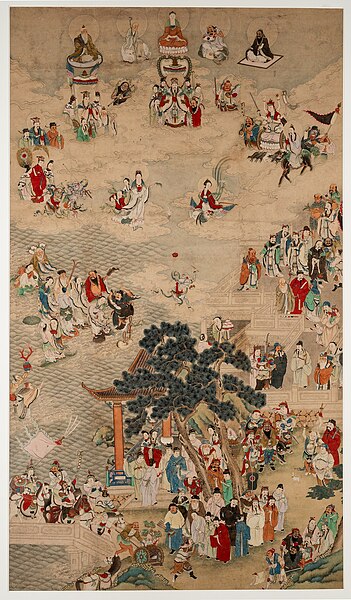
Qing dynasty painting of the Chinese pantheon.
Xuanyuan Temple in Huangling, Shaanxi, dedicated to the worship of the Yellow Emperor.
The Temple of the City God of Wen'ao, Magong, Taiwan.
Temple of Hebo ("River Lord"), the god (Heshen, "River god") of the sacred Yellow River, in Hequ, Xinzhou, Shanxi.


