Kosmos 954 was a reconnaissance satellite launched by the Soviet Union in 1977. A malfunction prevented safe separation of its onboard nuclear reactor; when the satellite reentered the Earth's atmosphere the following year, it scattered radioactive debris over northern Canada, some of the debris landing in the Great Slave Lake next to Fort Resolution, NWT.
Using hand-held radiation survey meters to find the debris
A nuclear reactor is a device used to initiate and control a fission nuclear chain reaction or nuclear fusion reactions. Nuclear reactors are used at nuclear power plants for electricity generation and in nuclear marine propulsion. Heat from nuclear fission is passed to a working fluid, which in turn runs through steam turbines. These either drive a ship's propellers or turn electrical generators' shafts. Nuclear generated steam in principle can be used for industrial process heat or for district heating. Some reactors are used to produce isotopes for medical and industrial use, or for production of weapons-grade plutonium. As of 2022, the International Atomic Energy Agency reports there are 422 nuclear power reactors and 223 nuclear research reactors in operation around the world.
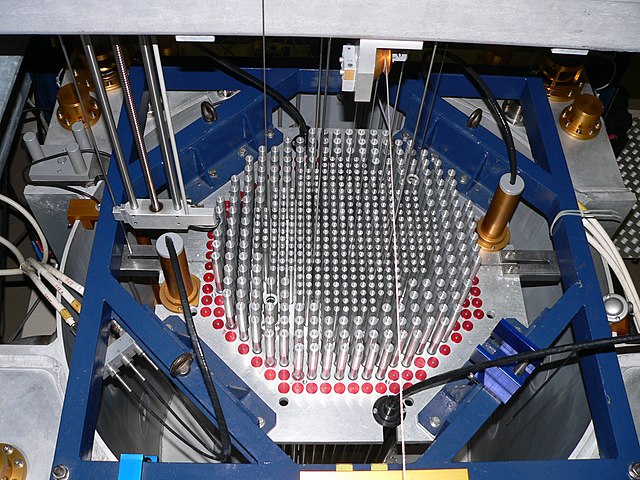
Core of CROCUS, a small nuclear reactor used for research at the EPFL in Switzerland
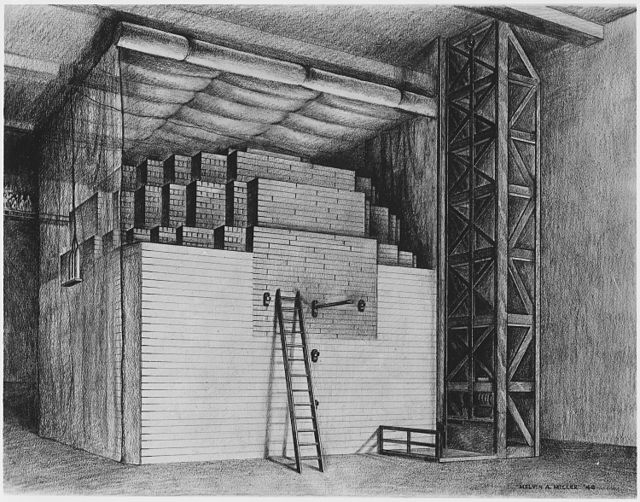
The Chicago Pile, the first artificial nuclear reactor, built in secrecy at the University of Chicago in 1942 during World War II as part of the US's Manhattan project
Lise Meitner and Otto Hahn in their laboratory
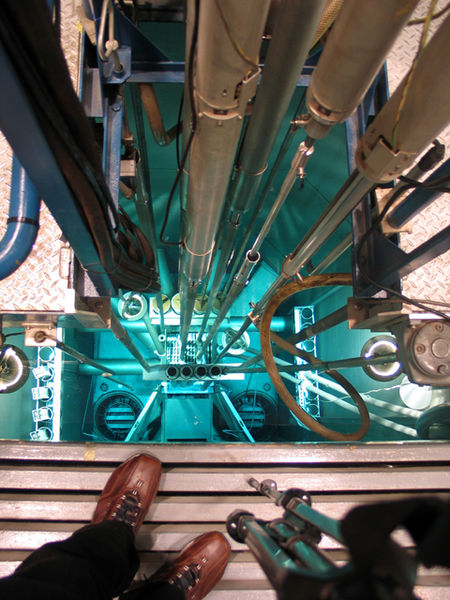
NC State's PULSTAR Reactor is a 1 MW pool-type research reactor with 4% enriched, pin-type fuel consisting of UO2 pellets in zircaloy cladding.