Kumarbi
Videos
Kumarbi, also known as Kumurwe, Kumarwi and Kumarma, was a Hurrian god. He held a senior position in the Hurrian pantheon, and was described as the "father of gods". He was portrayed as an old, depose

A copy of inscription of Tiš-atal on a foundation peg from Urkesh. Louvre.

The Muwatalli II-Alaksandu treaty, which mentions Kumarbi among the divine witnesses. Troy Museum.

A possible representation of scenes from the Song of Ullikummi on the golden bowl of Hasanlu
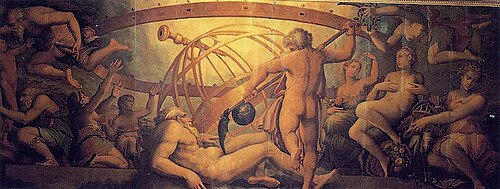
A 16th century painting by Giorgio Vasari and Cristoforo Gherardi showing the castration of Ouranos, a Greek myth possibly influenced by the Kumarbi Cycle.
El (deity)
Videos
El is a Northwest Semitic word meaning 'god' or 'deity', or referring to any one of multiple major ancient Near Eastern deities. A rarer form, 'ila, represents the predicate form in the Old Akkadian a
Kumarbi
…figures in the same myths. A trilingual version of the Weidner god list from Ugarit presents both Kumarbi and Enlil as the equivalents of the local god El. A tentative restoration of a bilingual version from Emar might also indicate he could be associated with Ištaran. The worship of Kumarbi is attested…

Gilded statuette of El from Ugarit

Gebel al-Arak knife Possible depiction of El with two lions, B.C. 3450

Gilded statue of El (c. 1400–1200 BC) from the site of Tel Megiddo.