LTV A-7 Corsair II
Videos
The LTV A-7 Corsair II is an American carrier-capable subsonic light attack aircraft designed and manufactured by Ling-Temco-Vought.

United States Navy A-7E from VA-146

The first A-7 mock-up in 1964

YA-7D-1-CV AF Serial No. 67-14582, the first USAF YA-7D, 2 May 1968. Note the Navy-style refueling probe (retracted beside the cockpit in the standard position, not the air test data probe on the nose cone, which is part of the flight testing equipment) and the modified Navy Bureau Number used as its USAF tail number.

A-7D-7-CV Corsair IIs 70-0976, 70-0989 and 70-0970 of the 354th Tactical Fighter Wing in the skies over Southeast Asia. '976 and '989 were retired to AMARC in 1992, '970 is on permanent display at the National Museum of the United States Air Force, Wright-Patterson AFB, Ohio.
Vought F-8 Crusader
Videos
The Vought F-8 Crusader is a retired single-jet engine, supersonic, carrier-based air superiority fighter designed and produced by the American aircraft manufacturer Vought. It was the last American f
LTV A-7 Corsair II
…by Ling-Temco-Vought (LTV). The A-7 was developed during the early 1960s as replacement for the Douglas A-4 Skyhawk. Its design was derived from the Vought F-8 Crusader; in comparison with the F-8, the A-7 is both smaller and restricted to subsonic speeds, its airframe being simpler and cheaper to produce. Following a…
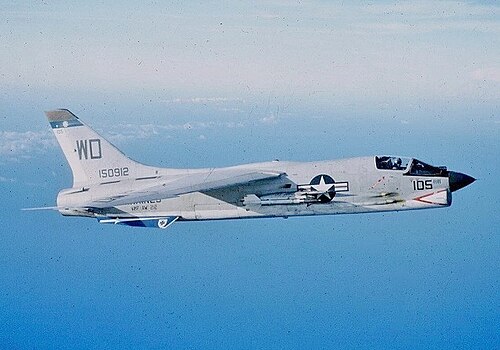
An F-8E from VMF(AW)-212 in 1965

F8U-1 Crusader BuNo 141435 and Commander "Duke" Windsor depart China Lake for a successful speed record attempt, 21 August 1956.

Two Crusaders prepare to launch from USS Midway; their variable-incidence wings are in the "up" position.

An F-8J of Oriskany intercepts a Tu-95 'Bear-B', 1974.