The Lakhmid dynasty, referred to in Arabic as al-Manādhirah or Banu Lakhm, was an Arab kingdom in Southern Iraq and Eastern Arabia, with al-Hirah as their capital, from the late 3rd century to 602 AD/CE. They were generally but intermittently the allies and clients of the Sasanian Empire, and participant in the Roman–Persian Wars. While the term "Lakhmids" has also been applied to the ruling dynasty, more recent scholarship prefers to refer to the latter as the Naṣrids.
The ruins of a building in al-Hira, the Lakhmids' capital city,
A Persian manuscript from the 15th century describing the constructing of al-Khornaq Castle in al-Hirah.
The Arabs, also known as the Arab people, are an ethnic group mainly inhabiting the Arab world in West Asia and North Africa. A significant Arab diaspora is present in various parts of the world.
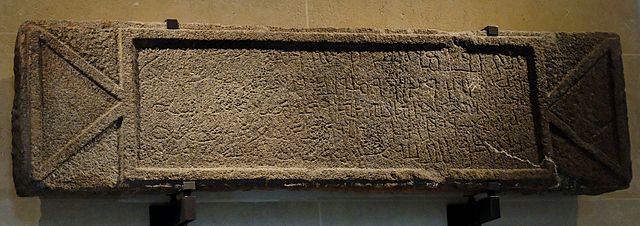
The Namara inscription is an Arabic epitaph in Nabataean script of Imru' al-Qais, son of "Amr, king of all the Arabs". Basalt, found at Nimreh in the Hauran (Southern Syria), dated 7 December 328 CE.
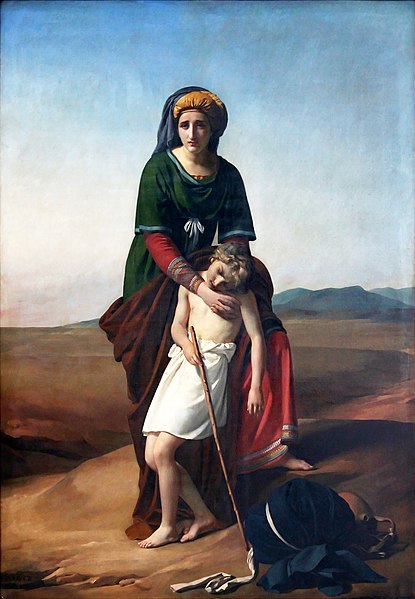
A depiction of Hagar and her son Ishmael in the desert (1819) by François-Joseph Navez
Al-Khazneh in Petra, capital of the Nabataean Kingdom, built as a mausoleum to Nabataean King Aretas IV in the first century AD
Receipt for garments sent by boat to Dilmun in the 1st year of Ibbi-Sin's rule, circa 2028 BCE.