Lamentation of Christ
Videos
The Lamentation of Christ is a very common subject in Christian art from the High Middle Ages to the Baroque. After Jesus was crucified, his body was removed from the cross and his friends mourned ove

Lamentation by Giotto, 1305

Medieval wall painting showing the sequence of Crucifixion, Deposition, Lamentation/Pietà, Anointing, with part of an Entombment or Resurrection on the extreme right

Ugolino Lorenzetti, c. 1350

Gerard David - Lamentation
Life of Christ in art
Videos
The Life of Christ as a narrative cycle in Christian art comprises a number of different subjects showing events from the life of Jesus on Earth. They are distinguished from the many other subjects in
Lamentation of Christ
…his friends mourned over his body. This event has been depicted by many different artists. Lamentation works are very often included in cycles of the Life of Christ, and also form the subject of many individual works. One specific type of Lamentation depicts only Jesus' mother Mary cradling his body. These are known…

16th-century Italian cycle in fresco by Gaudenzio Ferrari with 21 scenes from Annunciation to Resurrection: Top row: Annunciation, Nativity, Visit of the Three Magi, Flight to Egypt, Baptism of Christ, Raising of Lazarus, Entry to Jerusalem, Last Supper. Middle row: Washing of feet, Agony in the Garden, Arrest of Christ, Trial before the Sanhedrin, Trial before Pilate, Flagellation. Bottom row: Ecce homo, Carrying the cross, Christ falls, Crucifixion, Deposition from the cross, Harrowing of Hell, Resurrection.
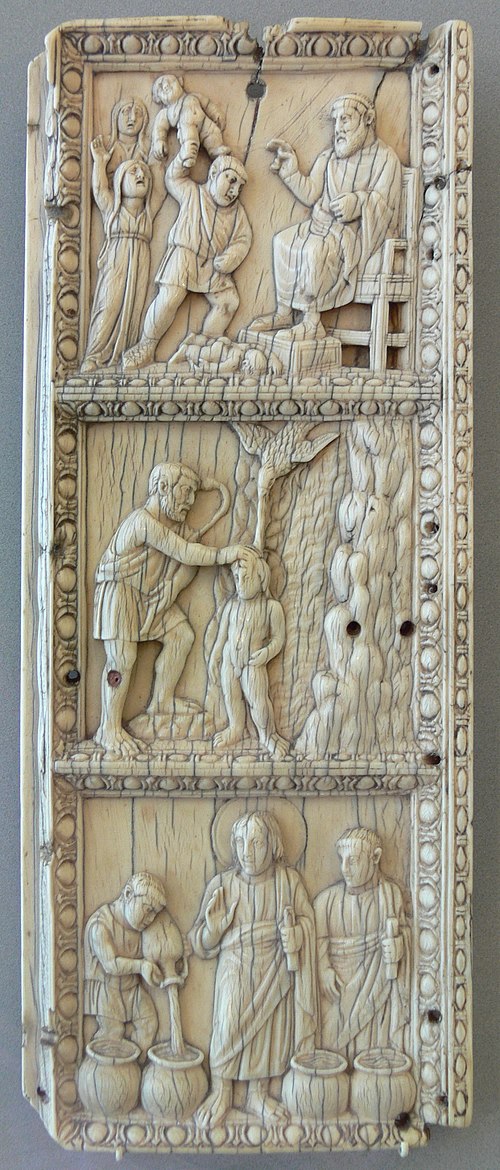
Ivory panel with the Massacre of the Innocents, Baptism of Christ, and Wedding at Cana, 1st third of 5th century

The Passion shown in a number of small scenes, c. 1490, from the Entry into Jerusalem through the Golden Gate (lower left) to the Ascension (centre top)
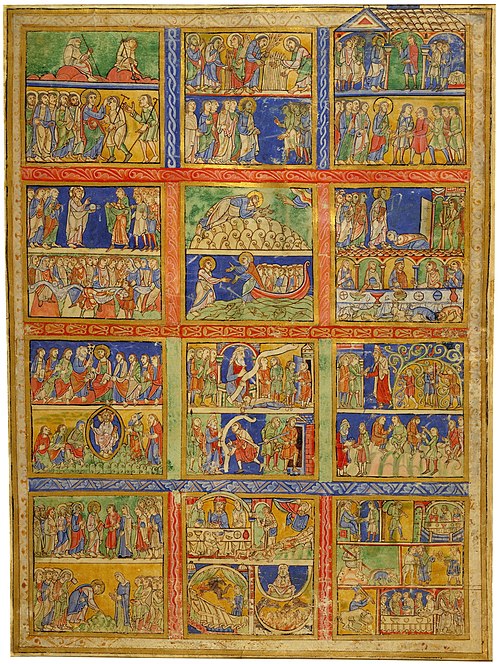
Eadwine Psalter, Morgan leaf M.521 (recto); mixed miracles and parables of Jesus. The last square has the story of the Prodigal Son in 8 scenes, the penultimate Dives and Lazarus in four.