There have been many extremely large explosions, accidental and intentional, caused by modern high explosives, boiling liquid expanding vapour explosions, older explosives such as gunpowder, volatile

Painting of the aftermath of the Delft explosion by Egbert van der Poel

A cropped interior view of Fort Fisher from the northeast angle showing the site of the reserve powder magazine that exploded.

The hole created by the Braamfontein dynamite explosion (looking west) at Maraisburg on 19 February 1896

HMS Queen Mary explodes during the Battle of Jutland
Port Chicago disaster
Videos
The Port Chicago disaster was a deadly munitions explosion of the ship SS E. A. Bryan on July 17, 1944, at the Port Chicago Naval Magazine in Port Chicago, California, United States. Munitions being l
Largest artificial non-nuclear explosions
…material(s) Approximate yield Mean yield Halifax Explosion Halifax, Nova Scotia, Canada 6 December 1917 High explosives 2.9 kt (12 TJ) 2.9 kt (12 TJ) Port Chicago disaster Port Chicago, California, United States 17 July 1944 Military ammunition 1.6–2.2 kt (6.7–9.2 TJ); some sources suggest as much as 5 kt 1.9 kt (7.9 TJ…

Damage at the Port Chicago Pier after the explosion of July 17, 1944

African American sailors of an ordnance battalion preparing 5-inch shells for packing at the Port Chicago Naval Magazine in 1943

Aerial photograph, looking eastward, taken between 1942 and 1944. The town of Port Chicago is in the upper right. The lower left shows utility and personnel piers extending toward the two sections of Seal Island. The munitions loading pier curves to the left beyond 20-odd revetments. Marshy tidal zones separate the munitions pier from barracks buildings near the personnel pier and near the town.
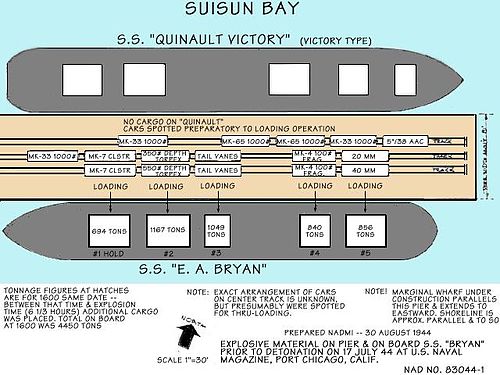
Graphic reconstruction of the pier, boxcars and ships at Port Chicago just before the explosion, with estimates of type and weight of cargo