Lee Waves
Videos
In meteorology, lee waves are atmospheric stationary waves. The most common form is mountain waves, which are atmospheric internal gravity waves. These were discovered in 1933 by two German glider pil

A Moazagotl lenticular cloud

A fluid dynamics lab experiment illustrates flow past a mountain-shaped obstacle. Downstream wave crests radiate upwards with their group velocity pointing about 45° from horizontal. A downslope jet can be seen in the lee of the mountain, an area of lower pressure, enhanced turbulence, and periodic vertical displacement of fluid parcels. Vertical dye lines indicate effects are also felt upstream of the mountain, an area of higher pressure.

A wave window over the Bald Eagle Valley of central Pennsylvania as seen from a glider looking north. The wind flow is from upper left to lower right. The Allegheny Front is under the left edge of the window, the rising air is at the right edge, and the distance between them is 3–4 km.

Hydrostatic wave (schematic drawing)
Internal wave
Videos
Internal waves are gravity waves that oscillate within a fluid medium, rather than on its surface. To exist, the fluid must be stratified: the density must change with depth/height due to changes, for
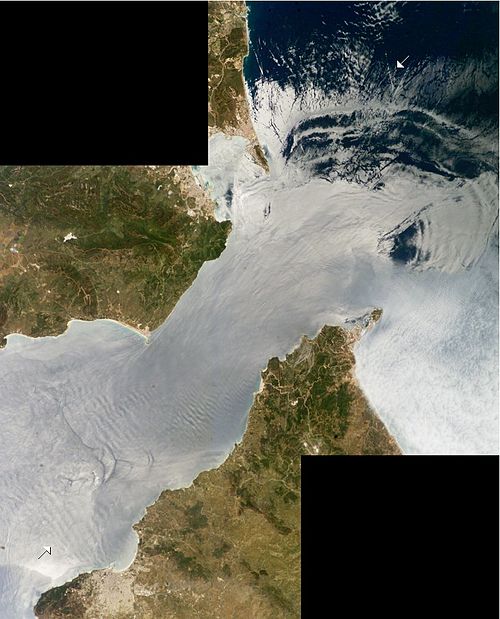
Internal waves (marked with arrows), caused by tidal flow through the Strait of Gibraltar and made visible by sea surface roughness enhance sunlight backscatter

Internal Wave trains around Trinidad, as seen from space