Legio XIII Gemina
Videos
Photos
Legio XIII Gemina, in English the 13th Twin(s) Legion ; was a legion of the Imperial Roman army. It was one of Julius Caesar's key units in Gaul and in the civil war, and was the legion with which he crossed the Rubicon in January, perhaps the 10th, 49 BC. The legion appears to have still been in existence in the 5th century AD. Its symbol was the lion.

Sestertius minted in 248 by Philip the Arab to celebrate the province of Dacia and its legions, V Macedonica and XIII Gemina. Note the eagle and lion, symbols on the reverse, respectively of legio V and legio XIII.

Stamped brick found at Alba Iulia, Romania
Julius Caesar
Videos
Photos
Gaius Julius Caesar was a Roman general and statesman. A member of the First Triumvirate, Caesar led the Roman armies in the Gallic Wars before defeating his political rival Pompey in a civil war, and subsequently became dictator from 49 BC until his assassination in 44 BC. He played a critical role in the events that led to the demise of the Roman Republic and the rise of the Roman Empire.

The Tusculum portrait, possibly the only surviving sculpture of Caesar made during his lifetime

Gaius Marius, Caesar's uncle and the husband of Caesar's aunt Julia. He was an enemy of Sulla and took the city with Lucius Cornelius Cinna in 87 BC.

Sulla, depicted on a coin minted by Quintus Pompeius Rufus in 54 BC. Sulla took the city in 82 BC, purged his political enemies, and instituted new constitutional reforms.
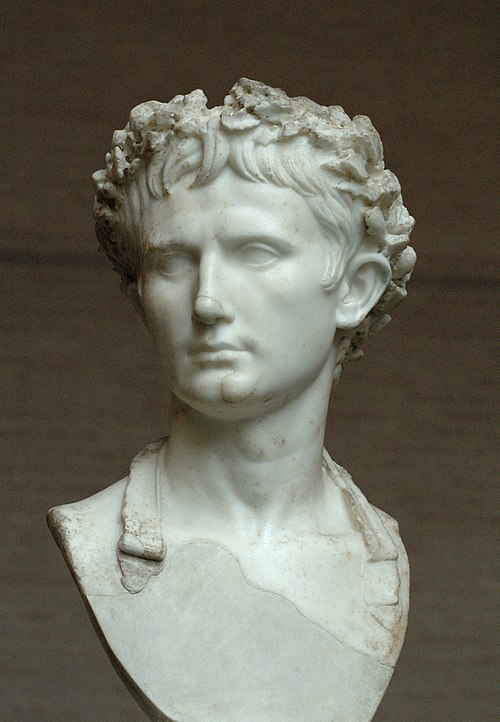
Bust, from the imperial period, of a man – in this case Augustus – wearing the civic crown (Latin: corona civica). Caesar won the civic crown for his bravery at the Siege of Mytilene in 81 BC.