Lernaean Hydra
Videos
The Lernaean Hydra or Hydra of Lerna, more often known simply as the Hydra, is a serpentine lake monster in Greek mythology and Roman mythology. Its lair was the lake of Lerna in the Argolid, which wa

Lernaean Hydra Getty Villa 83.AE.346

Pollaiuolo's Hercules and the Hydra (c. 1475). Uffizi Gallery, Florence, Italy

Portrait of Henri IV as Hercules pinning the Hydra of Lerna, an allegory of the Navarrese king's defeat of the Catholic League during the French Wars of Religion. Workshop of Toussaint Dubreuil, c. 1600.
Labours of Hercules
Videos
The Labours of Hercules or Labours of Heracles are a series of tasks carried out by Heracles, the greatest of the Greek heroes, whose name was later romanised as Hercules. They were accomplished in th
Lernaean Hydra
…established it as a sacred site older than Mycenaean Argos. In the canonical Hydra myth, the monster is killed by Heracles (Hercules) as the second of his Twelve Labours. According to Hesiod, the Hydra was the offspring of Typhon and Echidna. It had poisonous breath and blood so virulent that even its scent was deadly…
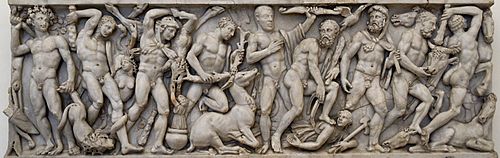
Roman relief (3rd century AD) depicting a sequence of the Labours, representing from left to right the Nemean lion, the Lernaean Hydra, the Erymanthian Boar, the Ceryneian Hind, the Stymphalian birds, the Girdle of Hippolyta, the Augean stables, the Cretan Bull and the Mares of Diomedes

Roman mosaic (3rd century CE) showing the Twelve Labours from Llíria (Valencia, Spain). Now in the Museo Arqueológico Nacional.

The Heracles Papyrus, a fragment of a 3rd-century CE Greek manuscript of a poem about the Labours of Heracles (Oxyrhynchus Papyrus 2331)

The Origin of the Milky Way by Jacopo Tintoretto, 1575