Liposome
Videos
A liposome is a small artificial vesicle, spherical in shape, having at least one lipid bilayer. Due to their hydrophobicity and/or hydrophilicity, biocompatibility, particle size and many other prope

Liposomes are composite structures made of phospholipids and may contain small amounts of other molecules. Though liposomes can vary in size from low micrometer range to tens of micrometers, unilamellar liposomes, as pictured here, are typically in the lower size range with various targeting ligands attached to their surface allowing for their surface-attachment and accumulation in pathological areas for treatment of disease.

Seven main categories for liposomes: multilamellar large (MLV), oligolamellar (OLV), small unilamellar (SUV), medium-sized unilamellar (MUV), large unilamellar (LUV), giant unilamellar (GUV) and multivesicular vesicles (MVV)).

A micrograph of phosphatidylcholine liposomes, which were stained with fluorochrome acridine orange. Method of fluorescence microscopy (1250-fold magnification).

Various types of phosphatidylcholine liposomes in suspension. Method of phase-contrast microscopy (1000-fold magnification). The following types of liposomes are visible: small monolamellar vesicles, large monolamellar vesicles, multilamellar vesicles, oligolamellar vesicles.
In cell biology, a vesicle is an organelle within or outside a cell, consisting of liquid or cytoplasm enclosed by a lipid bilayer.
Liposome
…A liposome is a small artificial vesicle, spherical in shape, having at least one lipid bilayer. Due to their hydrophobicity and/or hydrophilicity, biocompatibility, particle size and many…
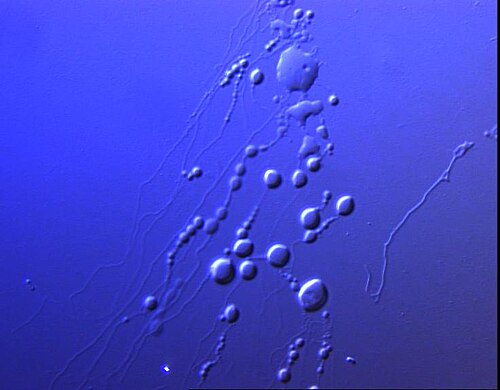
Sarfus image of lipid vesicles

Electron micrograph of a cell containing a food vacuole (fv) and transport vacuole (tv) in a malaria parasite