Liturgy of Preparation
Videos
The Liturgy of Preparation, also Prothesis or Proskomedia, is the name given in the Eastern Orthodox Church to the act of preparing the bread and wine for the Eucharist.
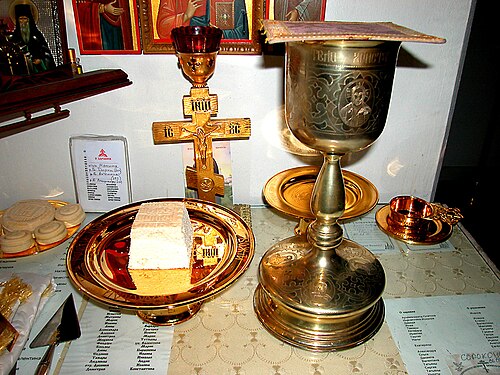
The Altar of Prothesis, set with the diskos (left), chalice (right) and other implements needed for the Liturgy of Preparation. The Lamb sits on the diskos (paten). To the left are Prosphora for the Theotokos, the saints, the living and the departed.
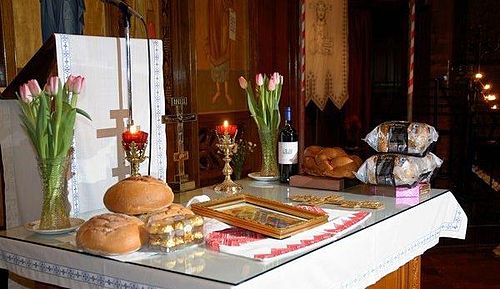
Prosphora prepared for the Liturgy of Preparation. The large loaves on the left are the five principal prosphora; the smaller loaves on the right are for the commemorations of the living and the dead by the faithful (Ukrainian Catholic Cathedral, London).

Liturgy of Preparation just before conclusion

The Lamb and particles placed on the diskos. The large triangle to the viewer's left of the Lamb is the particle for the Theotokos; to the right of the Lamb are the particles for the nine ranks (saints); below the Lamb are the particles commemorating the living and the departed.
Divine Liturgy
Videos
Divine Liturgy or Holy Liturgy is the usual name used in most Eastern Christian rites for the Eucharistic service.
Liturgy of Preparation
…given in the Eastern Orthodox Church to the act of preparing the bread and wine for the Eucharist. Only very specific elements may be offered at the Divine Liturgy: The bread used for the Liturgy is referred to as prosphora. A prosphoron is a round loaf of leavened bread baked in two layers to represent the two…

Icon of St. Basil the Great (left) and John Chrysostom, ascribed authors of the two most frequently used Eastern Orthodox Divine Liturgies, c. 1150 (mosaic in the Palatine Chapel, Palermo)

Church of Saint Sava, Christmas, Belgrade, 7 January 2021

Mass of Paul VI (post–Vatican II)

Tridentine Mass (1962 missal), Solemn Mass form