Liu Shaoqi
Videos
Liu Shaoqi was a Chinese revolutionary and politician. He was the chairman of the Standing Committee of the National People's Congress from 1954 to 1959, first-ranking vice chairman of the Chinese Com
Liu in 1959


Liu Shaoqi, 1927

Liu Shaoqi and Zhou Enlai, 1939

At the Sixth Plenary Session of the 6th Central Committee of the Chinese Communist Party in the autumn of 1938, from left to right: Mao Zedong, Peng Dehuai, Wang Jiaxiang, Zhang Wentian, Zhu De, Bo Gu, Wang Ming, Kang Sheng, Xiang Ying, Liu Shaoqi, Chen Yun, and Zhou Enlai.
Deng Xiaoping
Videos
Deng Xiaoping was a Chinese statesman, revolutionary, and political theorist who served as the paramount leader of the People's Republic of China from 1978 to 1989. Emerging as China's most influentia
Liu Shaoqi
…prison in 1969 due to complications from diabetes. Liu was widely condemned in the years following his death until he was posthumously rehabilitated by Deng Xiaoping's government in 1980, as part of the Boluan Fanzheng period. Deng's government granted Liu a national memorial service. According to his family genealogy…
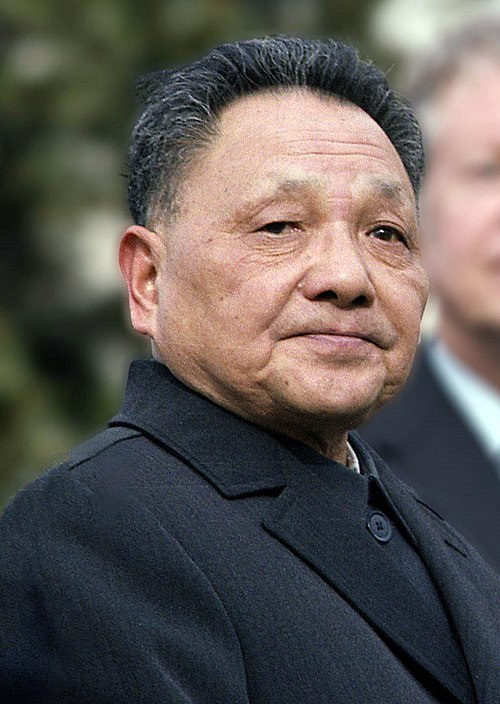
Deng in 1979

Deng Xiaoping at age 16, studying in France (1921)

Deng's name is spelled "Teng Hi Hien" on this employment card from the Hutchinson shoe factory in Châlette-sur-Loing, France, where he worked for eight months in 1922, and for another stint in 1923 where he was fired after one month, with the bottom note reading 'refused to work, do not take him back'

Deng Xiaoping in NRA uniform, 1937