Liza Dalby
Videos
Photos
Liza Crihfield Dalby is an American anthropologist and novelist specializing in Japanese culture. For her graduate studies, Dalby studied and performed fieldwork in Japan of the geisha community of Ponto-chō, which she wrote about in her Ph.D. dissertation, entitled The institution of the geisha in modern Japanese society. Since that time, she has written five books. Her first book, Geisha, was based on her early research. The next book, Kimono: Fashioning Culture is about traditional Japanese clothing and the history of the kimono. This was followed with a fictional account of the Heian era noblewoman Murasaki Shikibu, titled The Tale of Murasaki. In 2007 she wrote a memoir, East Wind Melts the Ice, which was followed two years later by a second work of fiction, Hidden Buddhas.

Murasaki Shikibu depicted in formal Heian period clothing in this 17th century illustration by Tosa Mitsuoki

Heian era court life depicted in a 19th century ukiyo-e illustration of The Tale of Genji by Hiroshige
Geisha
Videos
Photos
Geisha (芸者), also known as geiko (芸子) or geigi (芸妓), are female Japanese performing artists and entertainers trained in traditional Japanese performing arts styles, such as dance, music and singing, as well as being proficient conversationalists and hosts. Their distinct appearance is characterised by long, trailing kimono, traditional hairstyles and oshiroi make-up. Geisha entertain at parties known as ozashiki, often for the entertainment of wealthy clientele, as well as performing on stage and at festivals.

Profile of a Miyagawa-chō geiko (geisha) Kimiha wearing a formal black kimono (kurotomesode) and a chū taka shimada-style nihongami wig

A shikomi (left) accompanying the maiko Takamari of the Kaida okiya in Gion Kobu
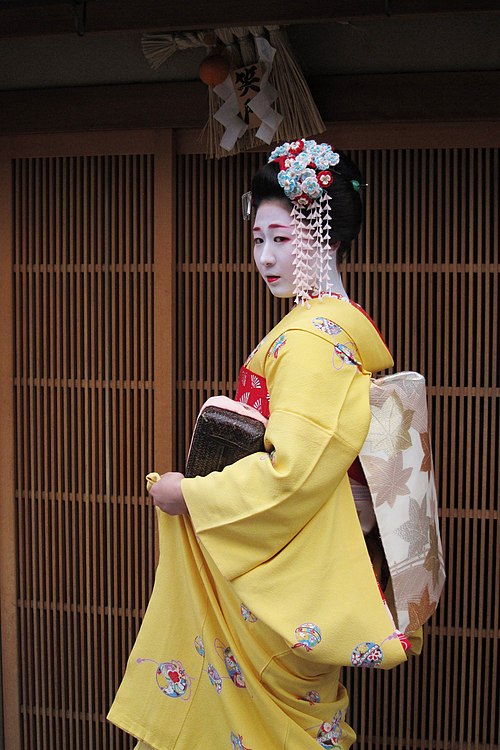
Minarai Katsunosuke wearing a short obi and a large, colourful set of kanzashi hairpins

Ukiyo-e scroll depicting a Gion geisha, 1800–1833