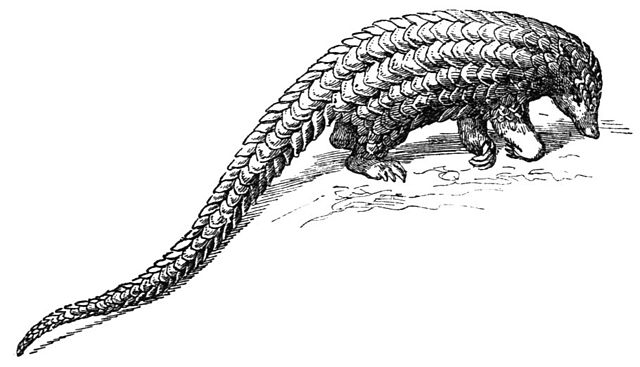
The long-tailed pangolin, also called the African black-bellied pangolin or ipi, is a diurnal, arboreal pangolin species belonging to the family Manidae, in the order Pholidota. They feed on ants rather than termites. The common names for this species stem from physical characteristics, such as the extremely long tail or the dark hairs that cover the underside of their bodies and limbs. Pangolin comes from the Malay word pengguling, meaning “something that rolls up”.
Long-tailed pangolin
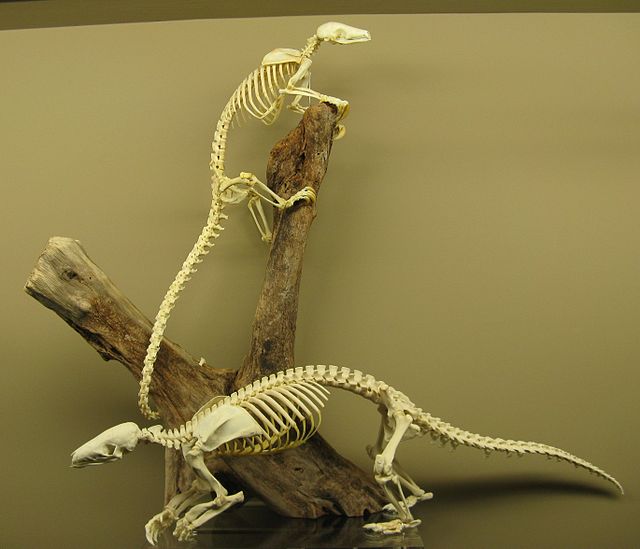
Skeleton at the Smithsonian Museum
Image: Schuppentier drawing
Pangolins, sometimes known as scaly anteaters, are mammals of the order Pholidota. The one extant family, the Manidae, has three genera: Manis, Phataginus, and Smutsia. Manis comprises four species found in Asia, while Phataginus and Smutsia include two species each, all found in sub-Saharan Africa. These species range in size from 30 to 100 cm. A number of extinct pangolin species are also known. In September 2023, nine species were reported.
Pangolin
Pangolin skeletons at the Museum of Osteology (2009)
Schematic drawing of pangolin scale histology
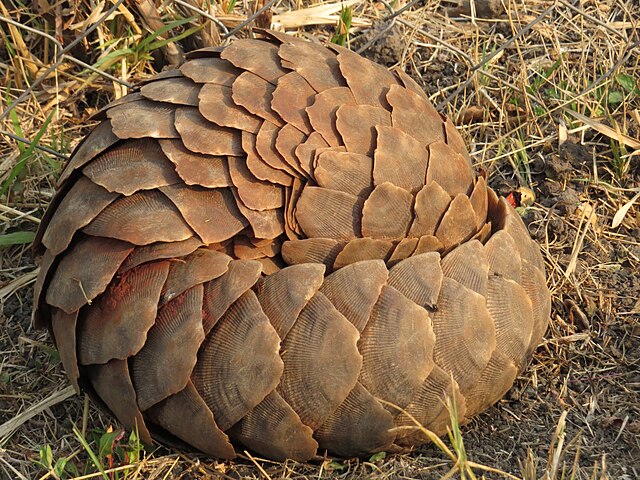
Ground pangolin in defensive posture