Lotus Sutra
Videos
The Lotus Sūtra is one of the most influential and venerated Buddhist Mahāyāna sūtras. It is the main scripture on which the Chinese Tiantai and its derivative schools—the Japanese Tendai and Nichiren

Sanskrit manuscript of the Lotus Sūtra in South Turkestan Brahmi script.

The Japanese title of the Lotus Sūtra (daimoku) depicted in a stone inscription.

In the parable of the burning house (shown in the upper part of this Korean illustration of the sūtra), a father uses three types of carts as a way to get his sons to exit a burning house. However, when they escape the fire, they all receive only one type of cart.

The Buddhas Prabhūtaratna and Shakyamuni seated side-by-side in the jeweled stupa. Bronze and gold stele, c. 518 CE, Northern Wei dynasty. China.
Nichiren Buddhism
Videos
Nichiren Buddhism, also known as Hokkeshū, is a branch of Mahayana Buddhism based on the teachings of the 13th-century Japanese Buddhist priest Nichiren and is one of the Kamakura period schools. Its
Lotus Sutra
…and venerated Buddhist Mahāyāna sūtras. It is the main scripture on which the Chinese Tiantai and its derivative schools—the Japanese Tendai and Nichiren, Korean Cheontae, and Vietnamese Thiên Thai schools of Buddhism—were established. It has also influenced other East Asian Buddhist schools, such as…
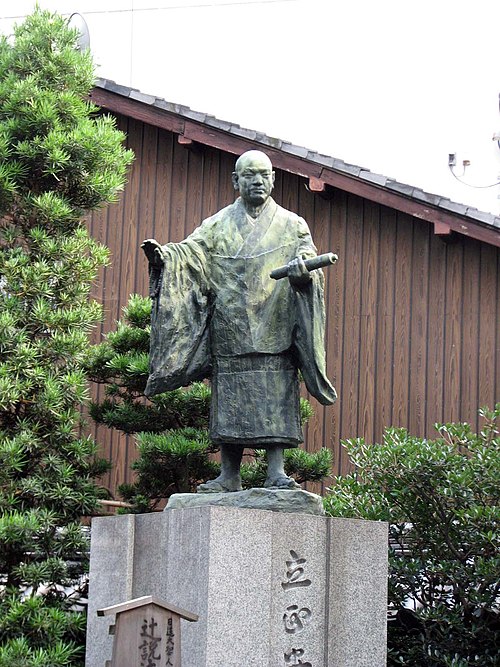
A bronze garden statue of Nichiren Daishonin in the Honnoji Temple of Nichiren Shu in Teramachi Street, Kyoto, Japan

An illustrated image of the Lotus Sūtra, which is highly revered in Nichiren Buddhism. From the Kamakura period, c. 1257. Ink, color, and gold leaf on paper.

Kamakura-period statue of Thousand-armed Kannon at Sanjūsangen-dō in Kyoto, Japan.

Sacred lotus Nelumbo nucifera