Ludi
Videos
Ludi were public games held for the benefit and entertainment of the Roman people . Ludi were held in conjunction with, or sometimes as the major feature of, Roman religious festivals, and were also presented as part of the cult of state.

Chariot races, as depicted on this 2nd-century relief, were among the ludi presented at Roman religious festivals

Terracotta plaque (1st century) depicting a venatio, or human-animal blood sport

Octavian crowned as Augustus
Gladiator
Videos
A gladiator was an armed combatant who entertained audiences in the Roman Republic and Roman Empire in violent confrontations with other gladiators, wild animals, and condemned criminals. Some gladiators were volunteers who risked their lives and their legal and social standing by appearing in the arena. Most were despised as slaves, schooled under harsh conditions, socially marginalized, and segregated even in death.
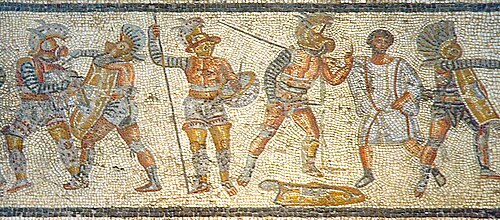
Part of the Zliten mosaic from Libya (Leptis Magna), about 2nd century AD. It shows (left to right) a thraex fighting a murmillo, a hoplomachus standing with another murmillo (who is signaling his defeat to the referee), and one of a matched pair.

Relief of gladiators from Amphitheatre of Mérida, Spain

A retiarius stabs at a secutor with his trident in this mosaic from the villa at Nennig, Germany, c. 2nd–3rd century AD.

Roman glassware decorated with a gladiator, dated 52–125 AD and found at Begram, Afghanistan, a royal city of the Kushan Empire where, according to Warwick Ball, it was likely on its way to Han dynasty China via the Silk Road along with other glass items.