Luigi Boccherini
Videos
Photos
Ridolfo Luigi Boccherini was an Italian composer and cellist of the Classical era whose music retained a courtly and galante style even while he matured somewhat apart from the major European musical centers. He is best known for a minuet from his String Quintet in E, Op. 11, No. 5, and the Cello Concerto in B flat major. The latter work was long known in the heavily altered version by German cellist and prolific arranger Friedrich Grützmacher, but has recently been restored to its original version.

Pencil drawing of Luigi Boccherini by Étienne Mazas after a portrait bust

Monument to Luigi Boccherini, Lucca

Boccherini playing the cello. Pompeo Batoni (c. 1764–1767)
Cello
Videos
Photos
The cello ( CHEL-oh), or violoncello ( VY-ə-lən-CHEL-oh, Italian pronunciation: [vjolonˈtʃɛllo]), is a bowed (sometimes plucked and occasionally hit) string instrument of the violin family. Its four strings are usually tuned in perfect fifths: from low to high, C2, G2, D3 and A3. The viola's four strings are each an octave higher. Music for the cello is generally written in the bass clef, with tenor clef, and treble clef used for higher-range passages.
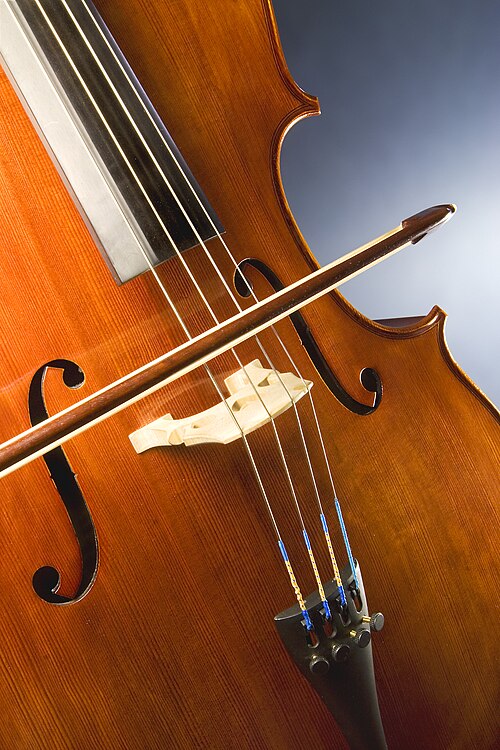
Cello close-up

Cello close-up with a bow.

A baroque cello strung with gut strings. Note the absence of fine-tuning pins on the tailpiece.

Josephine van Lier plays a violoncello piccolo, a five-string variant of the Baroque cello, during a recording session of Bach's 6th Cello Suite.