Lyra
Videos
Lyra is a small constellation in the Northern Sky. It is one of the 48 listed by the 2nd century astronomer Ptolemy, and is one of the modern 88 constellations recognized by the International Astronom
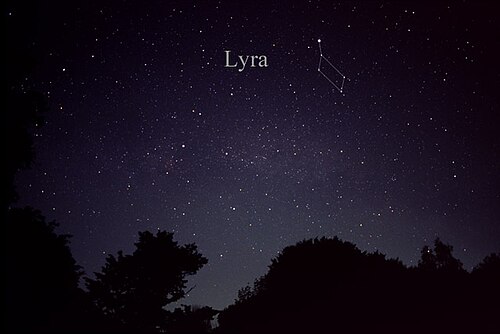
The constellation Lyra as it can be seen by the naked eye.

The constellation Lyra, enhanced for color and contrast. Brightest five stars are labeled.

A long-exposure image of Lyra

Messier 56 is composed of a large number of stars, tightly bound to each other by gravity. In Lyra are the objects M56, M57, and Kuiper 90. M56 is a rather loose globular cluster at a distance of approximately 32,900 light-years, with a diameter of about 85 light-years. Its apparent brightness is 8.3m.
Ring Nebula
Videos
The Ring Nebula is a planetary nebula in the northern constellation of Lyra, about mid-way between the prominent stars Beta and Gamma Lyrae. It is also catalogued as Messier 57, M57 and NGC 6720. The
Lyra
…and material flows from one to the other. Epsilon Lyrae, known informally as the Double Double, is a complex multiple star system. Lyra also hosts the Ring Nebula, the second-discovered and best-known planetary nebula. In Greek mythology, Lyra represents the lyre of Orpheus. Orpheus's music was said to be so great…

The Ring Nebula as seen in infrared and visible light by a multiple exposure of images from the James Webb Space Telescope's NIRCam, showing an outer layer of hydrogen that is very faint in visible light

HaRGB image of the Ring Nebula (M57) showing the faint outer shells. The spiral galaxy IC 1296 can also be seen in the top left. Data from the Liverpool Telescope on La Palma, Islas Canarias (Canary Islands), Spain.