Magdalenian
Videos
The Magdalenian is a technocomplex of the Late Upper Paleolithic in parts of Western and Central Europe. It dates from around 21,000 to 13,000 years Before Present. It is named after the type site of

Magdalenian cave painting
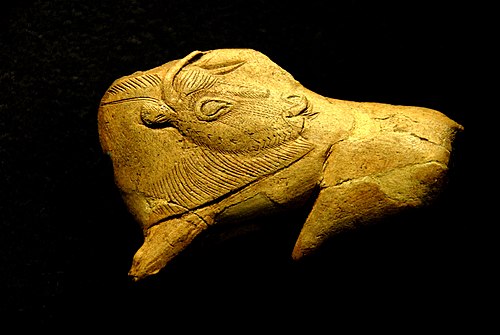
Bison Licking Insect Bite, a Magdalenian antler carving from France, dating to c. 15,000 years ago

Lascaux cave painting

Lascaux cave painting
Western hunter-gatherer
Videos
In archaeogenetics, western hunter-gatherer is a distinct ancestral component of modern Europeans, representing descent from a population of Mesolithic hunter-gatherers present across much of Western
Magdalenian
…who had retreated to southwestern Europe during the LGM. Madgalenian peoples were largely replaced by peoples belonging to the Epigravettian-associated Western Hunter Gatherer (WHG) genetic cluster at the end of the Pleistocene, though in the Iberian Peninsula early Holocene hunter-gatherers retained significant Madgalenian-related…

The transition from Magdalenian Goyet ancestry (green , Goyet Q2) to Western Hunter Gatherer (WHG) Villabruna ancestry (orange ) in European sites, according to timeline and climate evolution.

Cheddar Man, found in Great Britain, had a genotype similar to other western hunter-gatherers.

The rock shelter where the skeleton of the Loschbour man (c. 8,000 BP) was found

A simplified model for the demographic history of Europeans during the Neolithic period and the Neolithic Revolution which introduced agriculture.