Magnetic levitation
Videos
Magnetic levitation or magnetic suspension is a method by which an object is suspended with no support other than magnetic fields. Magnetic force is used to counteract the effects of the gravitational

Electromagnetic levitation device that includes a permanent magnet for primary force (big dark-gray ring), and electromagnets for stabilization (copper coils in the center)
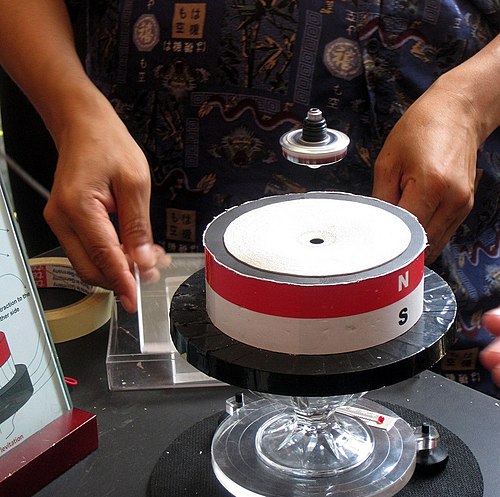
Magnetic levitation can be stabilised using different techniques; here rotation (spin) is used

A superconductor levitating a permanent magnet

An example of magnetic pseudo-levitation with a mechanical guide (wooden rod) providing stability
Magnetic bearing
Videos
A magnetic bearing is a type of bearing that supports a load using magnetic levitation. Magnetic bearings support moving parts without physical contact. For instance, they are able to levitate a rotat
Magnetic levitation
…not spontaneously slide or flip into a configuration where the lift is neutralized. Magnetic levitation is used for maglev trains, contactless melting, magnetic bearings, and for product display purposes. Magnetic materials and systems are able to attract or repel each other with a force dependent on the magnetic field…

A magnetic bearing

An axial homopolar electrodynamic bearing