Mameluke sword
Videos
A Mameluke sword is a cross-hilted, curved, scimitar-like sword historically derived from sabres used by Mamluk warriors of Ottoman Egypt after whom the sword is named. Egypt was, at least nominally,
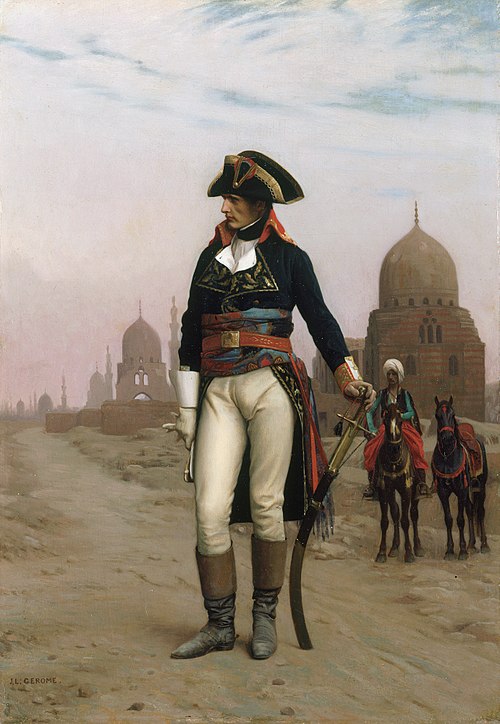
Jean-Léon Gérôme, Napoleon in Egypt, c. 1863, with a Mameluke sword, Princeton University Art Museum

Today's U.S. Marine Corps officers' Mameluke sword closely resembles those first worn in 1826.

Field Marshal Sir Henry Evelyn Wood, circa 1900

Charles Vane, 3rd Marquess of Londonderry, a British Hussar general, with a scabbarded kilij (related to Mameluke sword) of Turkish manufacture (1812)
Kilij
Videos
A kilij is a type of one-handed, single-edged and curved scimitar used by the Seljuk Empire, Timurid Empire, Mamluk Empire, Ottoman Empire, and other Turkic khanates of Eurasian steppes and Turkestan.
Mameluke sword
…Egypt was, at least nominally, part of the Ottoman Empire and the sword most commonly used in Egypt was the same as used elsewhere in the empire, the kilij. The curved sabre was originally of Central Asian Turkic in origin from where the style migrated to the Middle East, Europe, India and North Africa…

Various kilij from the Hellenic War Museum (Athens, Greece)

Ottoman kilij 19th century; this type with a short, broad blade is known as a "pala"; 27 in (69 cm) blade, 33 in (84 cm) total.

The upper sword appears to be an exaggerated parade piece or executioner's sword, the second down is typical of a later kilij, the third has the characteristics of an earlier kilij and the lowest one possibly has a later European-style blade. Imperial Armoury, Topkapi, Istanbul

Vienna, Treasury of the German Order. Ottoman sabres (17th century)