Mantra
Videos
A mantra or mantram is a sacred utterance, a numinous sound, syllable, word or phonemes, or group of words that practitioners believe to have religious, magical or spiritual powers. Some mantras have
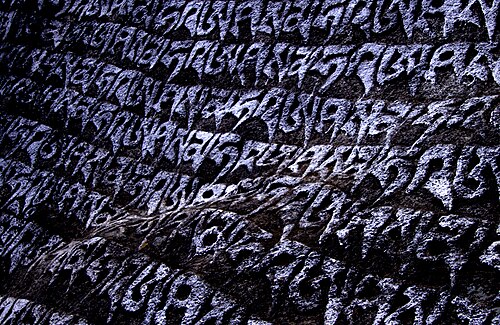
Mantras written on a rock near Namche Bazaar Nepal

Hare Krishna devotees in Amsterdam carrying a poster with the Hare Krishna Mantra

A personification of the Gayatri Mantra

Japanese Mandala of the Mantra of Light, an important mantra of the Shingon and Kegon sects
Om mani padme hum
Videos
Oṃ maṇi padme hūm̐ is the six-syllabled Sanskrit mantra particularly associated with the four-armed Shadakshari form of Avalokiteśvara, the Bodhisattva of compassion. It first appeared in the Mahayana
Mantra
…immortality, peace, love, knowledge, and action. Examples of longer mantras include the Gayatri Mantra, the Hare Krishna mantra, Om Namah Shivaya, the Mani mantra, the Mantra of Light, the Namokar Mantra, and the Mūl Mantar. Mantras without any actual linguistic meaning are still considered to be musically uplifting…

Stele of Sulaiman, erected at the Mogao Caves in 1348 to commemorate the donations of Sulaiman, Prince of Xining. It includes the six-syllable mantra written in six different scripts: Lantsa [1st row], Tibetan [2nd row], Uighur [far left], 'Phags-pa [left], Tangut [right], Chinese [far right].

A Tibetan sand mandala of Avalokitesvara, a key element of the tantric initiation ritual required to practice the mantra according to the Kāraṇḍavyūha

At Yonghe Temple, Beijing

"Om mani padme hūṃ", mani stone carved in Tibetan script outside the Potala Palace in Lhasa