Manuscript
Videos
A manuscript was, traditionally, any document written by hand or typewritten, as opposed to mechanically printed or reproduced in an indirect or automated way. More recently, the term has come to be u
Christ Pantocrator seated in a capital "U" in an illuminated manuscript from the Badische Landesbibliothek, Germany (from c. 1220)


Image of two facing pages of the illuminated manuscript of "Isagoge", fols. 42b and 43a. On the top of the left hand page is an illuminated letter "D" – initial of "De urinarum differencia negocium" (The matter of the differences of urines). Inside the letter is a picture of a master on bench pointing at a raised flask while lecturing on the "Book on urines" of Theophilus. The right hand page is only shown in part. On its very bottom is an illuminated letter "U" – initial of "Urina ergo est colamentum sanguinis" (Urine is thus the filtrate of the blood). Inside the letter is a picture of a master holding up a flask while explaining the diagnostic significance of urine to a student or a patient. HMD Collection, MS E 78.

Inside the letter is a picture of a master in cathedra expounding on the Aphorisms of Hippocrates. Initial "V" rendered as "U" of "Vita brevis, ars vero longa", or "Life is short, but the art is long". "Isagoge", fol. 15b. HMD Collection, MS E 78.

Manuscript, Codex Manesse. Most manuscripts were ruled with horizontal lines that served as the baselines on which the text was entered.
Illuminated manuscript
Videos
An illuminated manuscript is a formally prepared document where the text is decorated with flourishes such as borders and miniature illustrations. Often used in the Roman Catholic Church for prayers a
Manuscript
…the plural, just as pp. means "pages". A manuscript may be a codex (i.e. bound as a book), a scroll, or bound differently or consist of loose pages. Illuminated manuscripts are enriched with pictures, border decorations, elaborately embossed initial letters or full-page illustrations. Format: Scroll; Codex…

Illuminated manuscripts housed in the 16th-century Ethiopian Orthodox Church of Ura Kidane Mehret, Zege Peninsula, Lake Tana, Ethiopia
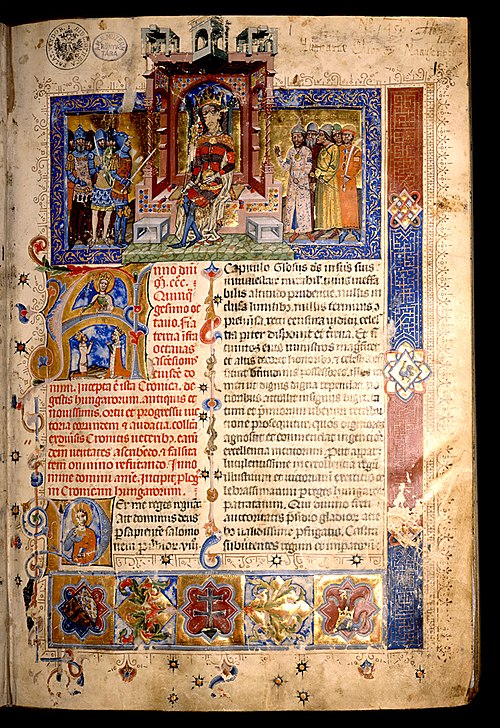
Chronicon Pictum, the "Illuminated Chronicle" from the court of King Louis the Great of Hungary from 1358

Frontispiece of the Maqamat al-Hariri (1237 CE) depicting a ruler in Turkic dress (long braids, Sharbush fur hat, boots, fitting coat), possibly Baghdad.

Sacrifice of Isaac, opening of Leviticus, detail of fol. 102r, Ambrosian Tanakh, made in Germany, ca. 1236–38, Biblioteca Ambrosiana