Marine habitat
Videos
A marine habitat is a habitat that supports marine life. Marine life depends in some way on the saltwater that is in the sea. A habitat is an ecological or environmental area inhabited by one or more living species. The marine environment supports many kinds of these habitats.


Only 29 percent of the world surface is land. The rest is ocean, home to the marine habitats. The oceans are nearly four kilometres deep on average and are fringed with coastlines that run for nearly 380,000 kilometres.

Land runoff, pouring into the sea, can contain nutrients
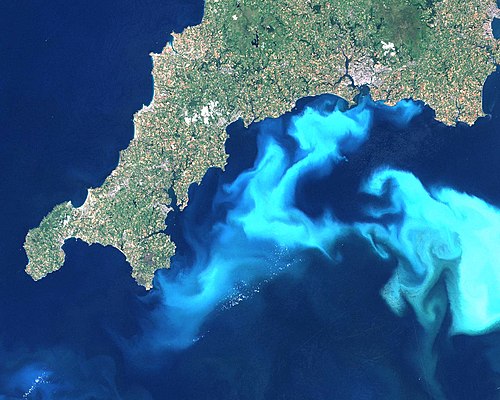
This algae bloom occupies sunlit epipelagic waters off the southern coast of England. The algae are maybe feeding on nutrients from land runoff or upwellings at the edge of the continental shelf.
Marine life
Videos
Marine life, sea life, or ocean life is the plants, animals, and other organisms that live in the salt water of seas or oceans, or the brackish water of coastal estuaries. At a fundamental level, marine life affects the nature of the planet. Marine organisms, mostly microorganisms, produce oxygen and sequester carbon. Marine life, in part, shape and protect shorelines, and some marine organisms even help create new land.

General characteristics of a large marine ecosystem (Gulf of Alaska)

Killer whales (orcas) are highly visible marine apex predators that hunt many large species. But most biological activity in the ocean takes place with microscopic marine organisms that cannot be seen individually with the naked eye, such as marine bacteria and phytoplankton.

Composition of seawater. Quantities in relation to 1 kg or 1 litre of sea water.

The Earth's water cycle