Marine prokaryotes
Videos
Marine prokaryotes are marine bacteria and marine archaea. They are defined by their habitat as prokaryotes that live in marine environments, that is, in the saltwater of seas or oceans or the brackis

Microbial mats are the earliest form of life on Earth for which there is good fossil evidence. The image shows a cyanobacterial-algal mat.
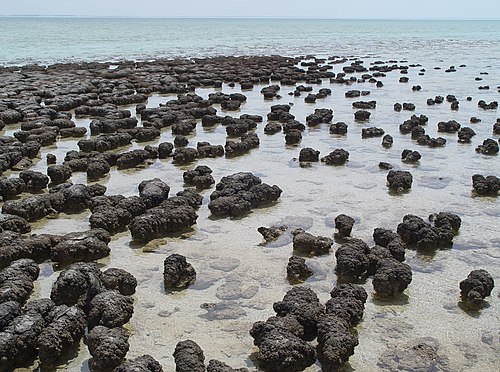
Stromatolites are formed from microbial mats as microbes slowly move upwards to avoid being smothered by sediment.

Sea spray containing marine microorganisms, including prokaryotes, can be swept high into the atmosphere where they become aeroplankton, and can travel the globe before falling back to earth.

Different bacteria shapes (cocci, rods and spirochetes) and their sizes compared with the width of a human hair. A few bacteria are comma-shaped (vibrio). Archaea have similar shapes, though the archaeon Haloquadratum is flat and square. The unit μm is a measurement of length, the micrometer, equal to 1/1,000 of a millimeter
Plankton
Videos
Plankton are organisms that drift in water but are unable to actively propel themselves against currents. Marine plankton include drifting organisms that inhabit the saltwater of oceans and the bracki
Marine prokaryotes
…microorganisms in the ocean, and it has been claimed that they are possibly the most abundant bacteria in the world. They make up about 25% of all microbial plankton cells, and in the summer they may account for approximately half the cells present in temperate ocean surface water. The total abundance of P. ubique…

Marine microplankton and mesoplankton Part of the contents of one dip of a hand net. The image contains diverse planktonic organisms, ranging from photosynthetic cyanobacteria and diatoms to many different types of zooplankton, including both holoplankton (permanent residents of the plankton like copepods) and meroplankton (temporary residents of the plankton like fish eggs and crab larvae). 100 μm is one tenth of a mm

The coccolithophore Emiliania huxleyi (μm = thousandth of one mm)
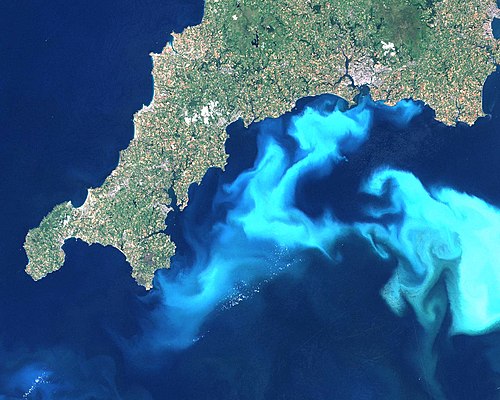
Algae bloom of Emiliania huxleyi off the southern coast of England

Plankton species diversity Diverse assemblages of unicellular and multicellular organisms with different sizes, shapes, feeding strategies, ecological functions, life cycle characteristics, and environmental sensitivities. Courtesy of Christian Sardet/CNRS/Tara expeditions