Marriage in ancient Rome
Videos
Marriage was a fundamental institution of society in ancient Rome and was used by Romans primarily as a tool for interfamilial alliances. The institution of Roman marriage was a practice of marital mo
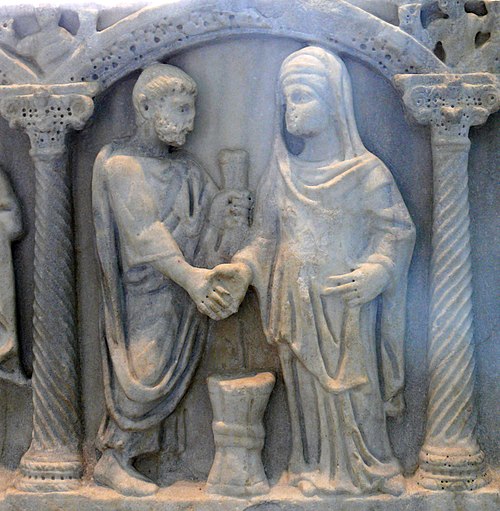
Roman couple joining hands (dextrarum iunctio); the bride's belt may show the knot symbolizing that the husband was "belted and bound" to her, which he was to untie in their bed (4th century sarcophagus)

Detail of a gold glass medallion with a portrait of a family, from Alexandria (Roman Egypt), 3rd–4th century (Brescia, Museo di Santa Giulia)

Inscription (CIL 14.5326) from Ostia Antica recording a decree that newlyweds are to pray and sacrifice before the altar to the imperial couple Antoninus Pius and Faustina as exemplifying Concordia, marital harmony

A groom encourages his demure bride while a servant looks on; wall painting, Casa della Farnesina in Rome (c. 19 BC)
Concubinatus
Videos
Concubinatus was a monogamous union, intended to be of some duration but not necessarily permanent, that was socially and to some extent legally recognized as an alternative to marriage in the Roman E

The concubina Fufia Chila is included in this family gravestone set up by Marcus Vennius Rufus to commemorate himself, his father and mother, and his wife (Museo Archeologico Nazionale di Napoli )

Fragment from an equestrian statue of Augustus (1st century BCE)

Gravestone set up by Gaius Caesius Faustus, the freedman of Gaius Caesius, for himself; his natural son, Gaius Caesius Nothus; his former master's son, Gaius Caesius; Valeria Galla, possibly his concubine, identified as the freedwoman of a Lucius Valerius; and Lucius Cornelius Eleutherus (1st century AD)