Mars surface color
Videos
The surface color of the planet Mars appears reddish from a distance because of rusty atmospheric dust. From close up, it looks more of a butterscotch, and other common surface colors include golden, brown, tan, and greenish, depending on minerals.
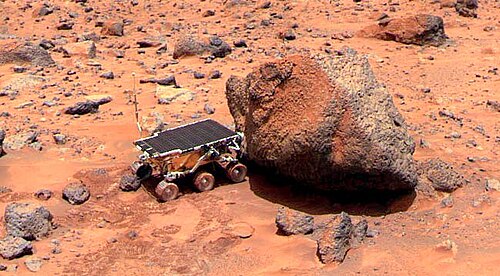
Yogi Rock, analyzed by the Sojourner rover (July 4, 1997)

Curiosity's view of Martian soil and boulders after crossing the "Dingo Gap" sand dune (February 9, 2014; raw color).

Rock-strewn surface imaged by Mars Pathfinder (July 4, 1997)
Martian soil
Videos
Martian soil is the fine regolith found on the surface of Mars. Its properties can differ significantly from those of terrestrial soil, including its toxicity due to the presence of perchlorates. The term Martian soil typically refers to the finer fraction of regolith. So far, no samples have been returned to Earth, the goal of a Mars sample-return mission, but the soil has been studied remotely with the use of Mars rovers and Mars orbiters.

Comparison of Soils on Mars - Samples by Curiosity, Opportunity, and Spirit rovers (December 3, 2012). (SiO2 and FeO are divided by 10, and Ni, Zn, and Br are multiplied by 100.)

First X-ray diffraction view of Martian soil - CheMin analysis reveals feldspar, pyroxenes, olivine and more (Curiosity rover at "Rocknest", October 17, 2012).

Mars without a dust storm in June 2001 (on left) and with a global dust storm in July 2001 (on right), as seen by Mars Global Surveyor