Mason–Dixon line
Videos
The Mason–Dixon line, sometimes referred to as Mason and Dixon's Line, is a demarcation line separating four U.S. states: Pennsylvania, Maryland, Delaware and West Virginia. It was surveyed between 17
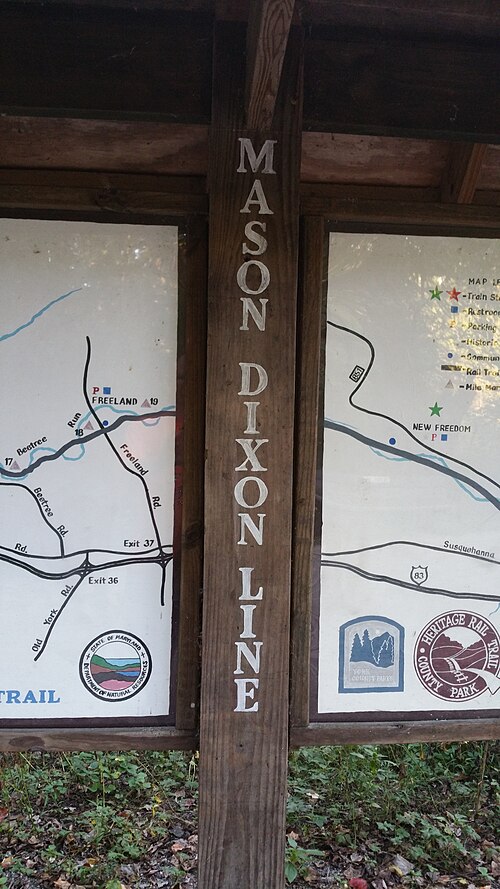
The Mason–Dixon line, where the Torrey C. Brown Rail Trail becomes the York County Heritage Trail near New Freedom, Pennsylvania

A historical marker at Front and South streets in Philadelphia, where the survey began
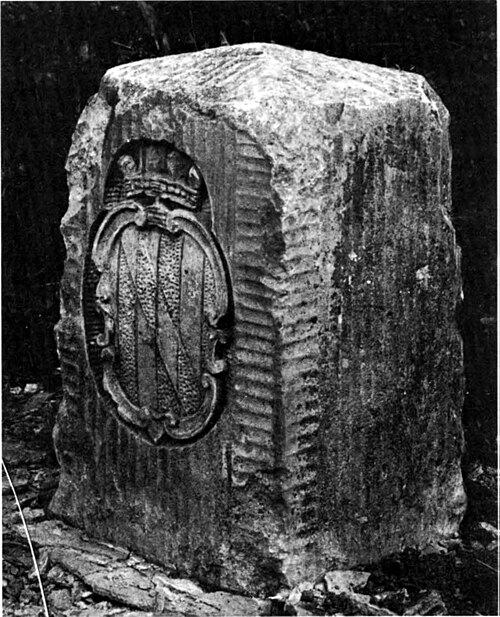
A crownstone boundary monument on the Mason–Dixon line; these markers were originally placed at every 5th mile (8.0 km) along the line, ornamented with family coats of arms facing the state they represented. The coat of arms of Maryland's founding Calvert family is shown; on the other side, are the arms of William Penn, who founded the Province of Pennsylvania

The Mason–Dixon Trail
Pennsylvania
Videos
Pennsylvania, officially the Commonwealth of Pennsylvania, is a state located in the Mid-Atlantic, Northeastern, Appalachian, and Great Lakes regions of the United States. The state borders Delaware t
Mason–Dixon line
…The Mason–Dixon line, sometimes referred to as Mason and Dixon's Line, is a demarcation line separating four U.S. states: Pennsylvania, Maryland, Delaware and West Virginia. It was surveyed between 1763 and 1767 by English surveyors and astronomers Charles Mason and Jeremiah Dixon as…

Shelter House in Emmaus, constructed in 1734 by Pennsylvania German settlers, is the oldest continuously occupied building structure in the Lehigh Valley and one of the oldest in Pennsylvania

Independence Hall in Philadelphia, where the Declaration of Independence and United States Constitution were adopted in 1776 and 1787–88, respectively

The Battle of Gettysburg, an 1887 portrait by Thure de Thulstrup depicting the Battle of Gettysburg, fought over three days from July 1 to 3, 1863, in Gettysburg. It was the deadliest battle ever fought on American soil and the bloodiest battle in all of American military history. But the Union army's victory at Gettysburg proved the Civil War's turning point, paving the way for the Union's ultimate victory two years later and the nation's preservation.

On November 19, 1863, President Abraham Lincoln (center, facing camera) traveled to present-day Gettysburg National Cemetery and delivered the Gettysburg Address, a 271-word address considered one of the most famous speeches in American history.