Mass
Videos
In physics, mass is an intrinsic positive physical quantity of a body, which measures its resistance to acceleration. In modern physics, it is generally defined as the strength of an object's gravitat

A 2 kg (4.4 lb) cast iron weight used for balances

Depiction of early balance scales in the Papyrus of Hunefer (dated to the 19th dynasty, c. 1285 BCE). The scene shows Anubis weighing the heart of Hunefer.

Galileo Galilei (1636)
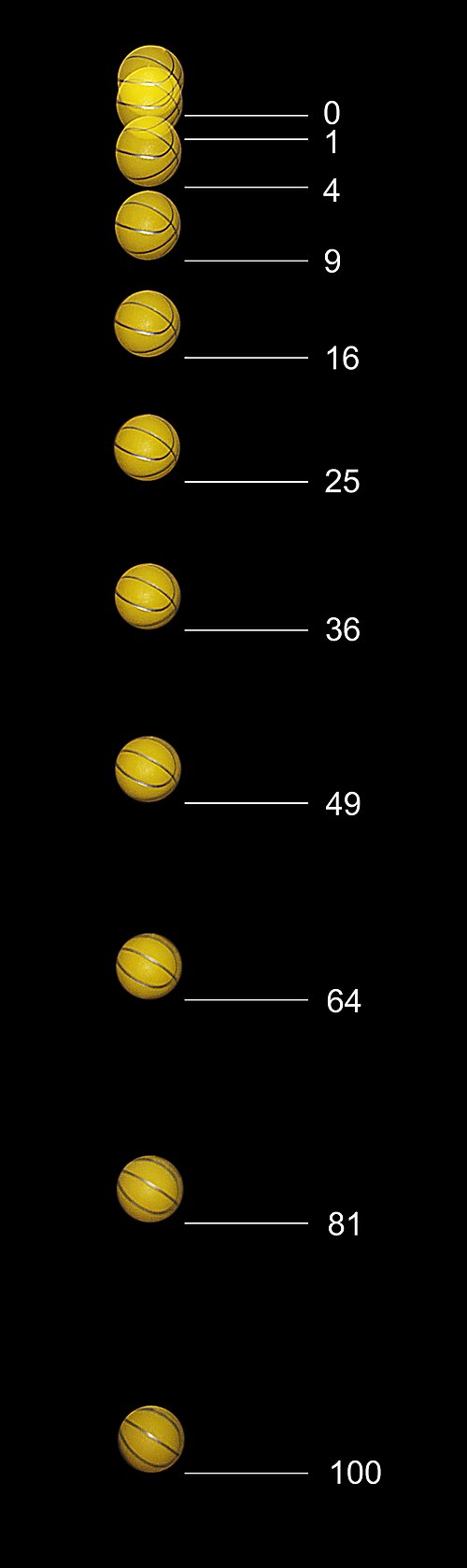
Distance traveled by a freely falling ball is proportional to the square of the elapsed time.
Mass–energy equivalence
Videos
In physics, mass–energy equivalence is the relationship between mass and energy in a system's rest frame. The two differ only by a multiplicative constant and the units of measurement. The principle i
Mass
…the International System of Units (SI) is the kilogram (kg). Since 1905, mass can also be understood as a measure of the energy content of a body (see E=mc²). Mass can be experimentally defined as a measure of the body's inertia, meaning the resistance to acceleration (change of velocity) when a net force…

Task Force One, the world's first nuclear-powered task force. Enterprise, Long Beach and Bainbridge in formation in the Mediterranean, 18 June 1964. Enterprise crew members are spelling out Einstein's mass–energy equivalence formula E = mc2 on the flight deck.

In the revised English edition of Isaac Newton's Opticks, published in 1717, Newton speculated on the equivalence of mass and light.

Albert Einstein in 1904/1905

The equation in Albert Einstein's own handwriting from 1912