Mathematics
Videos
Mathematics is a field of knowledge concerned with abstract concepts such as numbers, geometric shapes, sets, functions, and probabilities. It uses logical reasoning and proof to study and establish t
Illuminated letter P at the beginning of Adelard of Bath's translation of Euclid's Elements, which starts "Punctum est illud cui pars non est" ('A point is that which has no part'). Geometry is shown personified as a woman, following Martianus Capella's De nuptiis Philologiae et Mercurii.

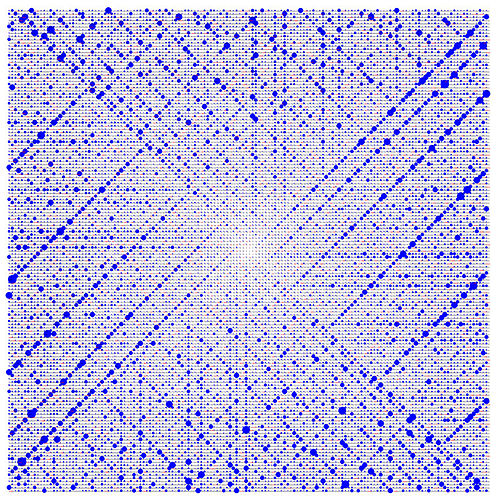
This is the Ulam spiral, which illustrates the distribution of prime numbers. The dark diagonal lines in the spiral hint at the hypothesized approximate independence between being prime and being a value of a quadratic polynomial, a conjecture now known as Hardy and Littlewood's Conjecture F.

On the surface of a sphere, Euclidean geometry only applies as a local approximation. For larger scales the sum of the angles of a triangle is not equal to 180°.

Image of Problem 14 from the Egyptian Moscow Mathematical Papyrus. The problem includes a diagram indicating the dimensions of the truncated pyramid.
Number theory
Videos
Number theory is a branch of mathematics devoted primarily to the study of the integers and arithmetic functions. Number theorists study prime numbers as well as the properties of mathematical objects
Mathematics
…is used to model and solve problems in science, engineering, technology, economics, and everyday life. There are many areas of mathematics, including number theory (the study of integers and their properties), algebra (the study of operations and the structures they form), geometry (the study of shapes and spaces…

The Babylonians demonstrated an early understanding of Pythagorean triples.

The Riemann hypothesis is of interest in analytic number theory.

Number theorists Paul Erdős and Terence Tao in 1985, when Erdős was 72 and Tao was 10

Riemann zeta function ζ(s) in the complex plane. The color of a point s gives the value of ζ(s): dark colors denote values close to zero and hue gives the value's argument.