Mauerpark is a public linear park in Berlin's Prenzlauer Berg district. The name translates to "Wall Park", referring to its status as a former part of the Berlin Wall and its Death Strip. The park is located at the border of Prenzlauer Berg and Gesundbrunnen district of former West Berlin.
Mauerpark seen from east to west, on the right floodlight masts of the Friedrich-Ludwig-Jahn-Sportpark
Mauerpark in Winter 2010
Mauerpark
Open Air Karaoke at Mauerpark
A linear park is a type of park that is significantly longer than it is wide. These linear parks are strips of public land running along canals, rivers, streams, defensive walls, electrical lines, or highways and shorelines. Examples of linear parks include everything from wildlife corridors to riverways to trails, capturing the broadest sense of the word. Other examples include rail trails, which are disused railroad beds converted for recreational use by removing existing structures. Commonly, these linear parks result from the public and private sectors acting on the dense urban need for open green space. Linear parks stretch through urban areas, coming through as a solution for the lack of space and need for urban greenery. They also effectively connect different neighborhoods in dense urban areas as a result, and create places that are ideal for activities such as jogging or walking. Linear parks may also be categorized as greenways. In Australia, a linear park along the coast is known as a foreshoreway. When being designed, linear parks appear unique as they are planned around the public's opinion of how the space will affect them.

Promenade Plantée, a 4.7 km (2.9 mi) elevated linear park built on top of obsolete railway infrastructure in the 12th arrondissement of Paris, France.
Plan of the Emerald Necklace, Boston, US, in 1894
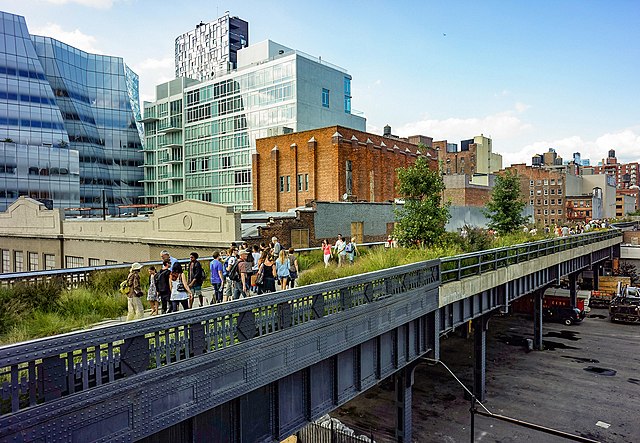
The High Line Park in Manhattan is an aerial greenway, modeled on the Promenade plantée in Paris.
William Sarjeant Park, a linear park in the Willowgrove neighborhood of Saskatoon, Saskatchewan, Canada