Maurya Empire
Videos
The Maurya Empire was a geographically extensive Iron Age historical power in South Asia with its power base in Magadha. Founded by Chandragupta Maurya around c. 320 BCE, it existed in loose-knit fash
A Pre-Mauryan to early-Mauryan terracotta statuette from Buxar, Bihar, ca. 4th century BCE (Bihar Museum, Arch. 6650).


Alexander the Great's empire in 326 BCE. The routes taken to South Asia and the return from South Asia to Babylon by land and sea are shown.

Alexander's eastern Satrapies, with territories ceded by the Seleucid Empire in 303 BCE.

Pataliputra, capital of the Mauryas. Ruins of pillared hall at Kumrahar site.
Ashoka
Videos
Ashoka, also known as Asoka or Aśoka, most commonly known as Ashoka the Great, was Emperor of Magadha from c. 268 BCE until his death, and the third ruler from the Mauryan dynasty. His empire covered
Maurya Empire
…the prevailing levels of technology and infrastructure limited how deeply his rule could penetrate society. During the rule of Chandragupta's grandson, Ashoka (ca. 268–232 BCE), the empire briefly controlled the major urban hubs and arteries of the subcontinent excepting the deep south. The Mauryan capital…

A c. 1st century BCE / CE relief from Sanchi, showing Ashoka on his chariot, visiting the Ramagrama

Ashoka's Major Rock Edict at Junagadh contains inscriptions by Ashoka (fourteen of the Edicts of Ashoka), Rudradaman I and Skandagupta.
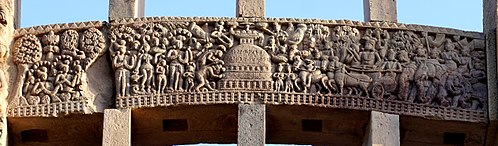
King Ashoka visits Ramagrama, to take relics of the Buddha from the Nagas, but in vain. Southern gateway, Stupa 1, Sanchi.