Mediterranean Sea
Videos
The Mediterranean Sea is an intercontinental sea situated between Europe, Asia, and Africa. It is surrounded by the Mediterranean basin and almost completely enclosed by land: on the east by the Levan

The Mediterranean Sea
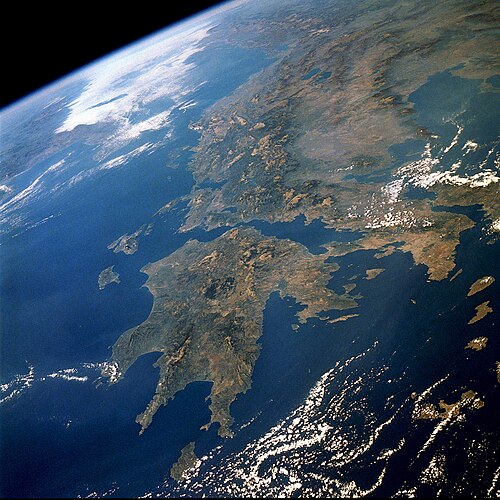
With its highly indented coastline and large number of islands, Greece has the longest Mediterranean coastline.

Greek (red) and Phoenician (yellow) colonies in antiquity c. the 6th century BC

The port and fleet of Genoa in the early 14th century, by Quinto Cenni
Zanclean flood
Videos
The Zanclean flood, or Zanclean deluge, is theorized to have refilled the Mediterranean Sea 5.33 million years ago. This flooding ended the Messinian salinity crisis and reconnected the Mediterranean
Mediterranean Sea
…Atlantic and was partly or completely desiccated over a period of some 600,000 years during the Messinian salinity crisis before being refilled by the Zanclean flood about 5.3 million years ago. The history of the Mediterranean region is crucial to understanding the origins and development of many modern societies…

Artistic interpretation of the flooding of the Mediterranean through the Strait of Gibraltar (A) and the Strait of Sicily (F) about 5.3 million years ago

Artistic interpretation of the flooding of the Mediterranean through the Strait of Gibraltar

Computer simulation of the flooding of the Mediterranean through the Strait of Gibraltar, with the vertical scale exaggerated for better visualization. The view in this image is from the southwest of Gibraltar, with the future Iberian Peninsula in the center-left, northwest Africa in the lower-right. The coastlines of Northern Europe in the top of this image do not correspond to the time period in question.