Meiji era
Videos
The Meiji era was an era of Japanese history that extended from October 23, 1868, to July 30, 1912. The Meiji era dominated the first half of the Empire of Japan, when the Japanese people moved from b
Emperor Meiji (1872)


The fifteen-year-old Meiji Emperor, moving from Kyoto to Tokyo at the end of 1868, after the fall of Edo

Emperor Meiji c. 1888
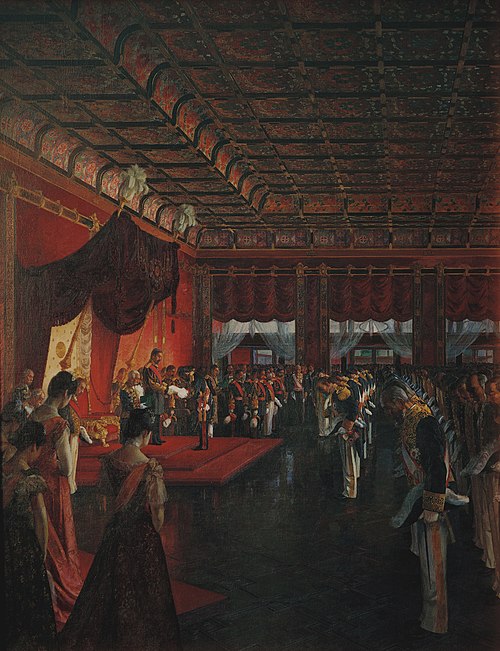
Ceremony for the Promulgation of the Constitution by Wada Eisaku, showing the Emperor presenting the Constitution to Prime Minister Kuroda Kiyotaka at a ceremony in the Imperial Palace on 11 February 1889 (Meiji Memorial Picture Gallery)
Emperor Meiji
Videos
Emperor Meiji; 3 November 1852 – 29 July 1912 was Emperor of Japan from 30 January 1867 until his death in 1912. The Meiji Restoration proclaimed the Empire of Japan in 1868, beginning the Meiji era.
Meiji era
…profound, and affected its social structure, culture, internal politics, economy, military, and foreign relations. The period corresponded to the reign of Emperor Meiji. It was preceded by the Keiō era and was succeeded by the Taishō era, upon the accession of Emperor Taishō following his father's death. The rapid…

Photograph by Uchida Kuichi, 1873

Mutsuhito's mother, Nakayama Yoshiko

Emperor Meiji wearing konoshi (小直衣), 1872