Mendele Mocher Sforim
Videos
Mendele Mocher Sforim was a Belarusian Jewish author and one of the founders of modern Yiddish and Hebrew literature.
Mendele Mocher Sforim

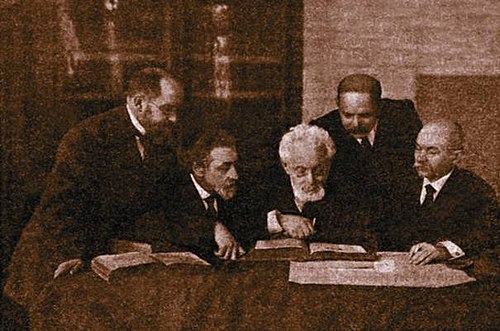
The Odessa literary group in 1916; from left to right: Yehoshua Ravnitzky (1859-1944), Shloyme Ansky, Mendele, Hayim N. Bialik, Simon Frug.
Kapyl
Videos
Kapyl is a town in Minsk Region, Belarus. It serves as the administrative center of Kapyl District. It is located 34 kilometers west-northwest of Slutsk and 90 kilometers south-southwest of the capita
Mendele Mocher Sforim
…was a Belarusian Jewish author and one of the founders of modern Yiddish and Hebrew literature. Mendele was born to a poor Lithuanian Jewish family in Kapyl, Minsk Governorate, Russian Empire. His father, Chaim Moyshe Broyde, died shortly after Mendele's bar mitzvah. He studied in yeshiva in Slutsk and Vilna…

Complex of buildings on Lenin Square in Kapyl

Former Catholic Church of Saints Peter and Paul

Local museum