Mesopotamia
Videos
Mesopotamia is a historical region of West Asia situated within the Tigris–Euphrates river system, in the northern part of the Fertile Crescent. It corresponds roughly to the territory of modern Iraq.

The Tigris river flowing through the region of modern Mosul in Upper Mesopotamia.

Mesopotamian Marshes at night, southern Iraq. A reed house (Mudhif) and a narrow canoe (Mashoof) are in the water. Mudhif structures have been one of the traditional types of structures, built by the Marsh people of southern Mesopotamia for at least 5,000 years. A carved elevation of a typical mudhif, dating to around 3,300 BC was discovered at Uruk.

One of 27 Statues of Gudea, a ruler around 2090 BC

After early starts in Jarmo (red dot, c. 7500 BC), the civilization of Mesopotamia in the 7th–5th millennium BC was centered around the Hassuna culture in the north, the Halaf culture in the northwest, the Samarra culture in central Mesopotamia and the Ubaid culture in the southeast, which later expanded to encompass the whole region.
Akkadian Empire
Videos
The Akkadian Empire or the Kingdom of Akkad/Agade was an ancient kingdom established around 2334 BCE, and the first empire in world history, succeeding the long-lived city-states of Sumer. Centered on
Mesopotamia
…cursive script, mathematics, astronomy, and agriculture." It is recognised as the cradle of some of the world's earliest civilizations. The Sumerians and Akkadians, each originating from different areas, dominated Mesopotamia from the beginning of recorded history (c. 3100 BC) to the fall of Babylon in 539 BC. The…

Bronze head of an Akkadian ruler, discovered in Nineveh in 1931, presumably depicting either Sargon or, more probably, Sargon's grandson Naram-Sin.

Sargon on his victory stele, with a royal hair bun, holding a mace and wearing a flounced royal coat on his left shoulder with a large belt (left), followed by an attendant holding a royal umbrella. The name of Sargon in cuneiform ("King Sargon") appears faintly in front of his face. Louvre Museum.
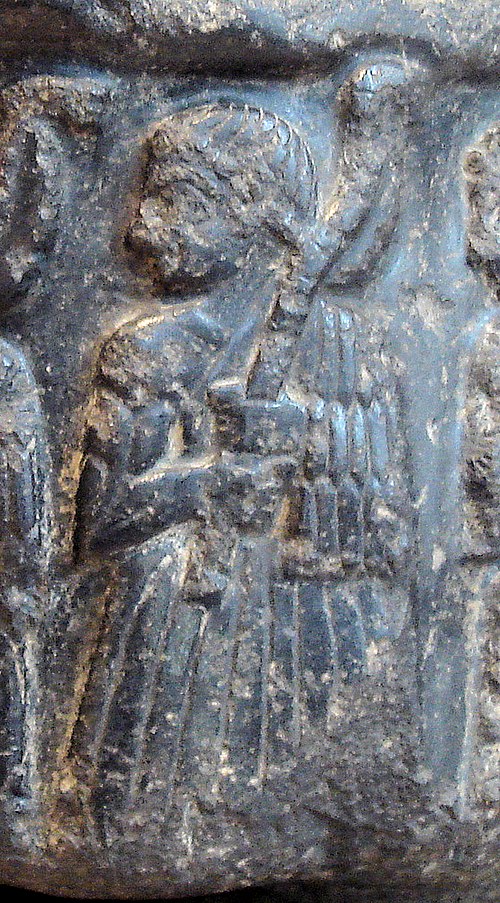
Akkadian official in the retinue of Sargon of Akkad, holding an axe

Prisoners escorted by a soldier, on a victory stele of Sargon of Akkad, circa 2300 BC. The hairstyle of the prisoners (curly hair on top and short hair on the sides) is characteristic of Sumerians, as also seen on the Standard of Ur. Louvre Museum.