Messier 87
Videos
Messier 87 is a supergiant elliptical galaxy in the constellation Virgo that contains several trillion stars. One of the largest and most massive galaxies in the local universe, it has a large populat
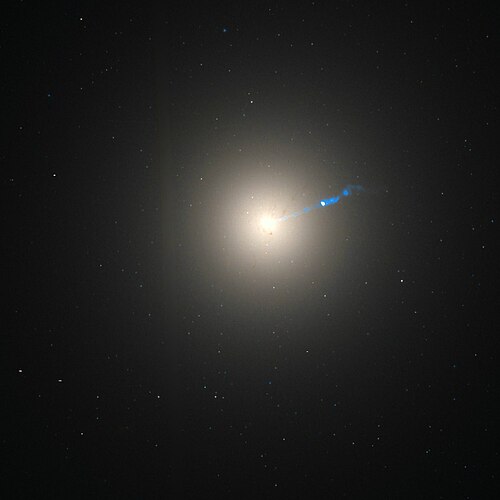
Messier 87, with the blue plasma jet of its galactic core clearly visible (composite image of observations by the Hubble Space Telescope in visible and infrared light)

In Hubble's galaxy classification scheme, M87 is an E0 galaxy.
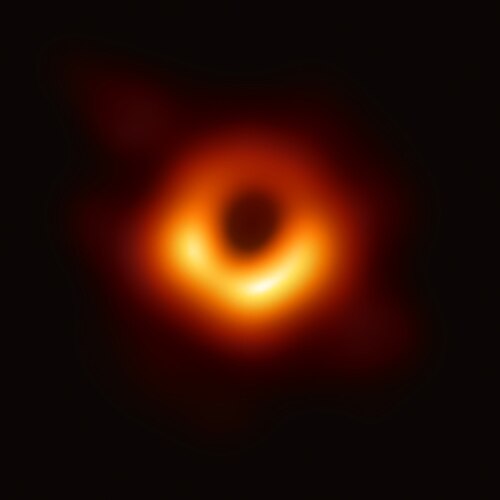
The Event Horizon Telescope image of the core of M87 using 1.3 mm microwaves. The central dark spot is the shadow of M87* and is larger than the black hole's event horizon.

A view of the jet and shadow of M87's black hole. Observations from the Global Millimetre VLBI Array (GMVA), the Atacama Large Millimeter/submillimeter Array (ALMA), and the Greenland Telescope.
Supermassive black hole
Videos
A supermassive black hole is the largest type of black hole, with its mass being on the order of hundreds of thousands, or millions to billions, of times the mass of the Sun. Black holes are a class o
Messier 87
…stars have a nearly spherically symmetric distribution. Their population density decreases with increasing distance from the core. It has an active supermassive black hole at its core, which forms the primary component of an active galactic nucleus. The black hole was imaged using data collected in 2017 by the Event Horizon…

The first direct image of a supermassive black hole, found in the galactic core of Messier 87.

An artist's conception of a supermassive black hole surrounded by an accretion disk and emitting a relativistic jet.

Artist's impression of the huge outflow ejected from the quasar SDSS J1106+1939

Artist's illustration of galaxy with jets from a supermassive black hole