Metal foam
Videos
Photos
In materials science, a metal foam is a material or structure consisting of a solid metal with gas-filled pores comprising a large portion of the volume. The pores can be sealed or interconnected. The defining characteristic of metal foams is a high porosity: typically only 5–25% of the volume is the base metal. The strength of the material is due to the square–cube law.

Foamed aluminium

Regular foamed aluminium

Manufacturing process of a regular metal foam by direct molding, CTIF process

As the strain and applied load on composite metal foam increases, the ability to withstand stress grows. Unlike solid materials that reach their ultimate strength very quickly, composite metal foam slowly builds to its ultimate strength, absorbing energy in the process.
Foam
Videos
Photos
Foams are materials formed by trapping pockets of gas in a liquid or solid.
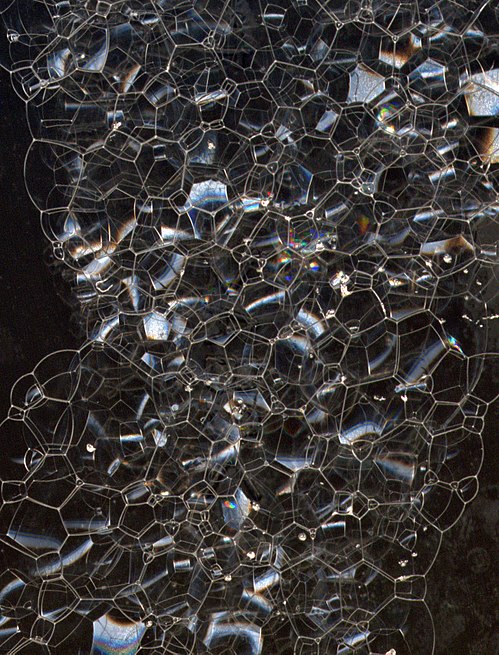
Soap foam bubbles

Cleaning sponge

Top of a foamy drink

Schematic stress-strain curve of an elastomeric foam, demonstrating the three regions which are linear elastic, cell-wall buckling, and cell-wall fracture. The area under the curve specified represents the energy per unit volume the foam can absorb.